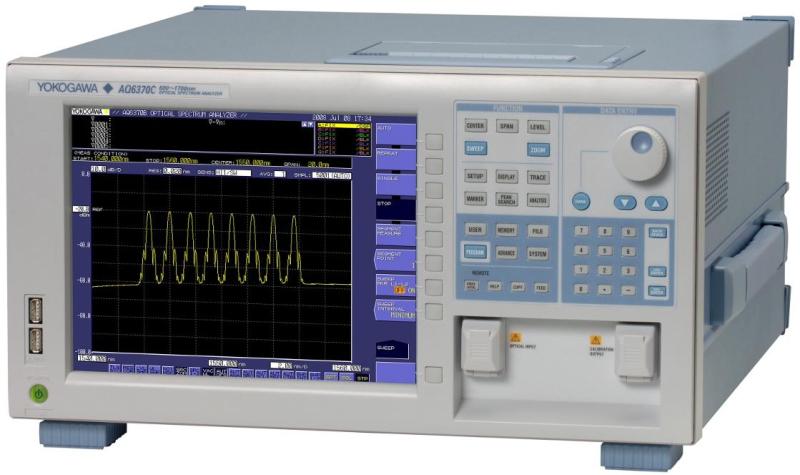
Yokogawa AQ6370C optical spectrum analyzer repair
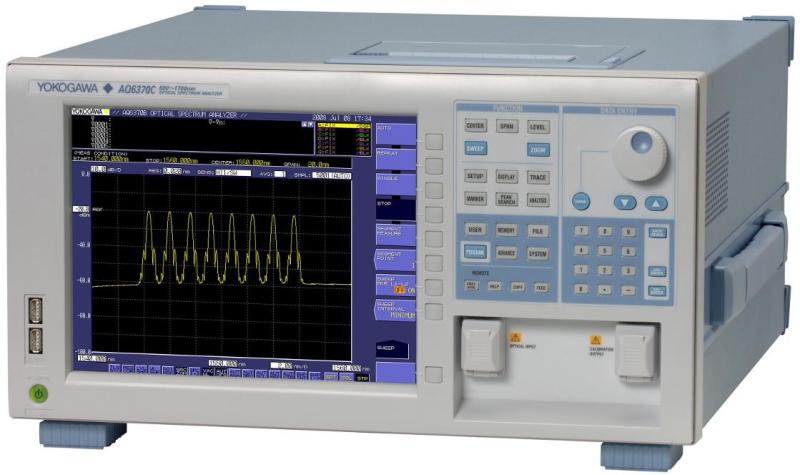
The AQ6370C was discontinued in 2014. Labs still run it daily. That gap between "no longer made" and "no longer needed" is exactly where we work.
Yokogawa stopped making the AQ6370C over a decade ago. The instrument itself has not stopped being useful. It covers 600 to 1700nm, resolves to 0.02nm, hits 78dB close-in dynamic range in the high-performance model, and sweeps 100nm in 0.2 seconds. Those numbers still hold up against current production instruments, which is why the AQ6370C remains in active production test and R&D use at labs that bought it new and see no reason to replace what is working.
The catch with a discontinued precision instrument is what happens when it stops working. Yokogawa will still take them in for service, but lead times on legacy instruments through OEM channels are not fast. Parts availability for older monochromator assemblies is tighter than it was. The economics of factory service on a ten-plus-year-old instrument also look different than they did when the unit was current.
That is where independent component-level repair makes sense. We know the AQ6370C platform. We stock parts for it. Most repairs turn in 1 to 3 business days.
What the AQ6370C Gets Wrong Over Time
The monochromator is the heart of the instrument. It uses a DC servo motor to drive the diffraction grating, an encoder to detect rotating angle, and a feedback control loop to hold wavelength accuracy within ±0.01nm on the high-performance model. That servo system has mechanical components that wear. When the encoder or drive degrades, wavelength accuracy suffers in ways that are not always obvious during normal use but show up immediately against a reference source. A unit that swept fine two years ago might now be 0.03nm off at 1550nm and nobody has noticed because no one has run a reference check.
FC/APC input connector wear is the most frequently presenting hardware fault. The free-space input design depends on precision alignment at the connector interface. Sleeve wear from repeated mating cycles introduces alignment error, which shows up as power reading instability, loss of sensitivity, or input coupling that varies with how the fiber is seated. On a 10-year-old instrument that has connected thousands of fibers, this is not a question of if but when.
Stray light performance degrades when the internal optical path picks up contamination. The AQ6370C's monochromator design separates first and second optical paths to achieve close-to-theoretical cascade performance. Contamination anywhere along that path adds stray light that compresses dynamic range in ways that look like a calibration problem but do not go away after recalibration.
The built-in wavelength reference source weakens over time. The AQ6370C uses this source for its auto-alignment and auto-calibration routines. A degraded reference source means the instrument is calibrating itself to a moving target. The symptom is wavelength calibration that drifts between power cycles or does not hold stable across a temperature change.
Communication interface failures on the AQ6370C most often hit the Ethernet port after voltage events. GPIB, which is the older control interface on this instrument, is more robust but not immune. Either failure takes the instrument out of remote control service in automated test builds.
The Repair
Diagnostic first, every time. We run DFB reference sources at 1310 and 1550nm to establish wavelength accuracy, verify sweep speed and dynamic range, check all communication interfaces, and inspect the input connector and optical path condition. You get a repair estimate based on what we actually found, not a flat rate that may or may not cover what is wrong.
Component-level repair means we fix what is broken, not what is convenient. Monochromator drive components get replaced, not worked around. The reference source gets checked and replaced if it is degrading. The connector interface gets rebuilt, not shimmed. NIST-traceable calibration with a certificate comes with every completed unit. So does a test report with pre-repair and post-repair measurements. You get a paper trail.
Service Specifications
| Parameter | Value |
|---|---|
| Wavelength Range | 600nm to 1700nm |
| Resolution Bandwidth | 0.02nm minimum |
| Wavelength Accuracy (HP model) | ±0.01nm (C band) |
| Wavelength Accuracy (Standard) | ±0.02nm (C+L band) |
| Close-in Dynamic Range | 78dB typical (HP model) |
| Level Sensitivity | -90dBm (1300 to 1620nm, HIGH3) |
| Sweep Speed | 0.2 sec / 100nm span |
| Sampling Points | 50,001 max |
| Interface | GPIB, Ethernet, USB |
| Input | FC/APC free-space |
Service specifications
| Parameter | Value |
|---|---|
| Wavelength range | 600 nm to 1700 nm |
| Resolution bandwidth | 0.02 nm minimum |
| Dynamic range | 78 dB |
| Interface | GPIB, Ethernet, USB |
Frequently asked questions
My unit was calibrated recently but wavelength accuracy is already drifting again. What is happening?
Is it worth repairing an AQ6370C or should we upgrade to an AQ6370D or E?
Documents
Also in inventory - buy a tested unit
We also sell refurbished Yokogawa AQ6370C units that have been verified and are ready to ship.