
Used Lock-In Amplifiers for Sale
6 units in stock — Stanford Research Systems, EG&G/Princeton, and more. DSP and analog dual-phase lock-in amplifiers, plus low-noise preamplifiers. Ships from Pleasant Grove, UT.
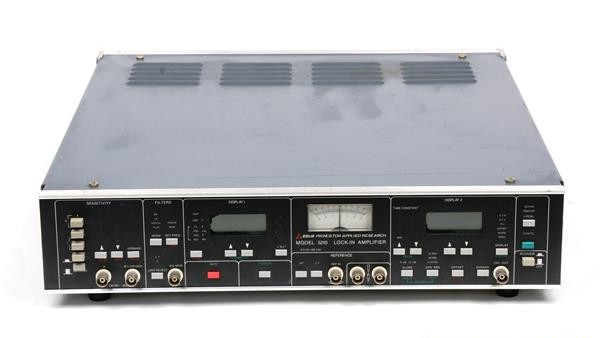
Ametek / EG&G / Princeton Applied Research (1 unit)
EG&G (1 unit)
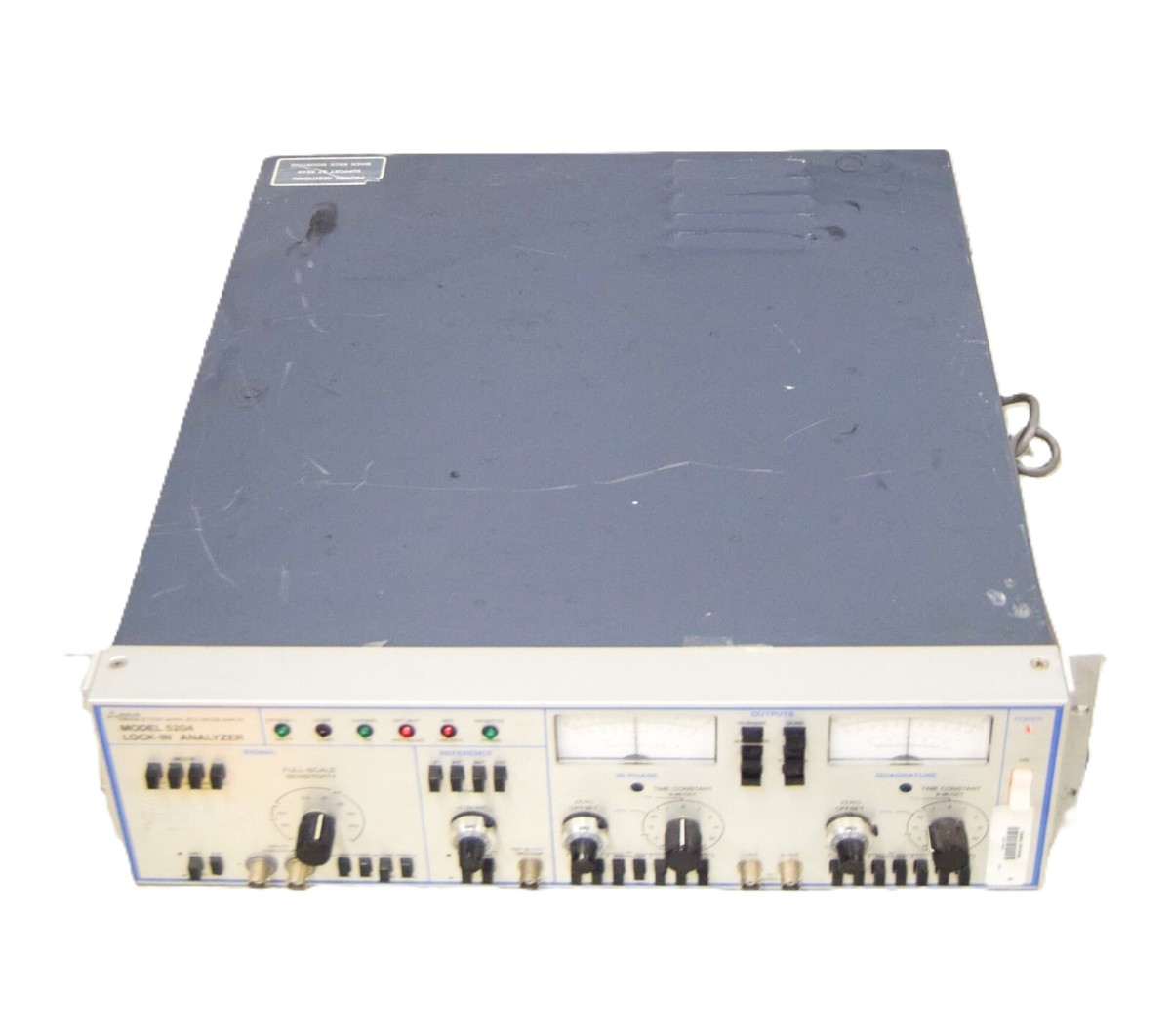
EG&G Princeton (1 unit)
Stanford Research (1 unit)
Stanford Research Systems (2 units)
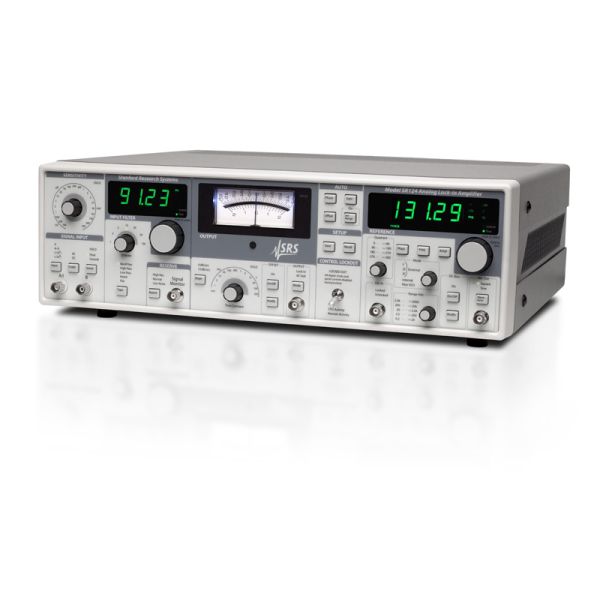
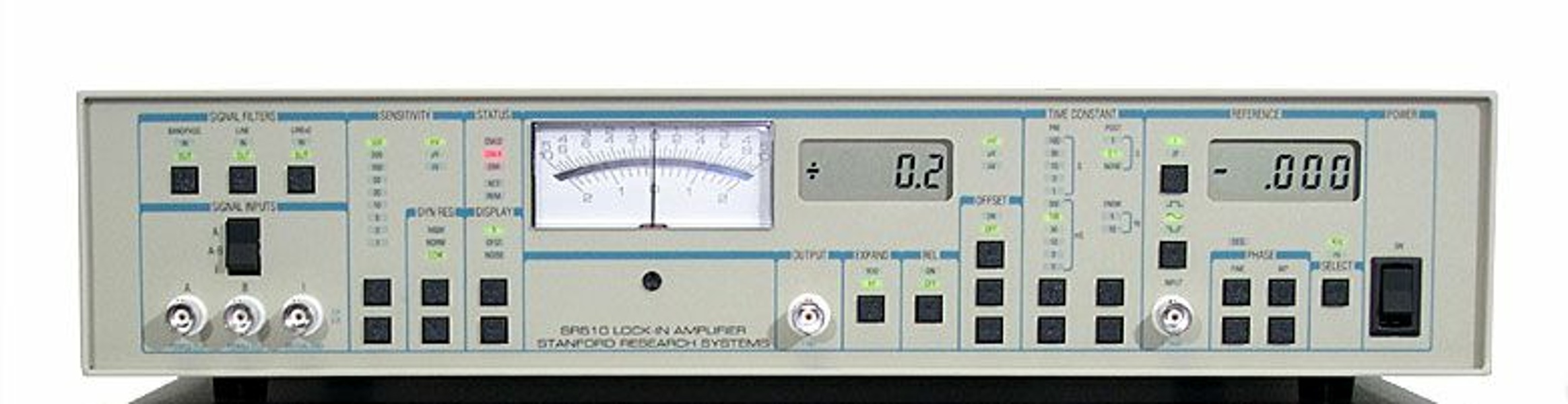
Stanford Research Systems Lock-In Amplifiers
Stanford Research Systems (SRS) is the dominant manufacturer of research-grade lock-in amplifiers. The SR510 (single-phase, analog) and SR530 (dual-phase, analog) are older instruments widely available at low cost — suitable for well-isolated signals where the higher dynamic reserve of DSP instruments is not needed. The SR810, SR830, SR850, SR860, and SR865 are DSP instruments that use digital signal processing to achieve better dynamic reserve (100 dB or more) and eliminate the phase and offset errors of analog demodulators. The SR865 extends the frequency range to 4 MHz, covering the RF range for some applications. All SR8xx instruments are rack-mountable and support GPIB/RS-232 remote control.
Frequently Asked Questions
What is a lock-in amplifier and what is it used for? +
A lock-in amplifier is a phase-sensitive detector that extracts a signal at a specific frequency from a noisy background. It works by mixing the input signal with a reference signal at the same frequency, then applying a low-pass filter to the result. Signals at the reference frequency produce a DC output; all other frequencies are rejected. This allows detection of signals buried 100 dB below the noise floor. Lock-in amplifiers are used in optical spectroscopy (modulating a chopped light beam), resistance measurements on thin films and semiconductors (modulating the excitation current), magnetic measurements, and any experiment where a periodic excitation is used and the signal is contaminated by broadband noise or interference.
What is the difference between the Stanford Research SR830 and SR850? +
Both are DSP dual-phase lock-in amplifiers covering 1 mHz to 102.4 kHz. The SR830 has 100 dB dynamic reserve and 6 nV/√Hz input noise — it was the standard research lock-in for two decades. The SR850 adds a larger graphical display, data storage, and a slightly extended frequency range. For most research applications the SR830 is adequate and costs significantly less on the used market. The SR860 (the current production model) adds a faster ADC and extends to 500 kHz. When comparing used SR830 vs SR850, the SR830 is often the better value unless you specifically need the SR850's display or data logging features.
What does dynamic reserve mean in a lock-in amplifier? +
Dynamic reserve is the ratio of the largest tolerable interfering signal to the smallest measurable signal, expressed in dB. A lock-in with 100 dB dynamic reserve can measure a 1 µV signal in the presence of a 100 mV interfering signal at a nearby frequency. High dynamic reserve is important when the signal frequency is close to a strong interference source — power line harmonics, motor drives, or RF pickup. However, high dynamic reserve settings increase settling time and reduce accuracy. The correct approach is to set dynamic reserve as low as needed: if your measurement bandwidth is far from any interference, use low reserve and faster time constants.
What reference frequency range should I choose? +
Choose the reference frequency to place your signal in a region free from interference. The first rule is to avoid 50/60 Hz and its harmonics (100/120, 150/180 Hz, etc.) — line frequency pickup is the dominant interference in most labs. The second rule is to avoid the 1/f noise corner of your detector or amplifier — usually below 10 Hz for silicon photodiodes, below 1 Hz for GaAs detectors. For optical chopper experiments, 200 Hz to 2 kHz is a good starting range: above the line harmonics and below the bandwidth limit of most mechanical choppers. For electrical transport measurements, 13.7 Hz or 17.3 Hz are traditional choices because they avoid common interference frequencies.
What low-noise preamplifiers work well with lock-in amplifiers? +
Stanford Research SR560 and SR570 preamplifiers are specifically designed to pair with lock-in amplifiers. The SR560 is a low-noise voltage preamplifier with 4 nV/√Hz input noise and 1 MHz bandwidth — used ahead of the lock-in when source impedances are below about 10 kΩ. The SR570 is a low-noise current preamplifier with sensitivity down to 1 pA/V — used when the signal source is a current (photodiode, ionization chamber, electrode). DL Instruments (formerly Ithaco) 1201 and 1211 are alternatives with different noise characteristics. The choice between voltage and current amplifier depends on the source impedance: use voltage preamp when source impedance is low, current preamp when source impedance is high.
Need a specific frequency range or noise floor?
Tell us your required frequency range, minimum detectable signal, and dynamic reserve requirement and we will check available stock.
Get in touch