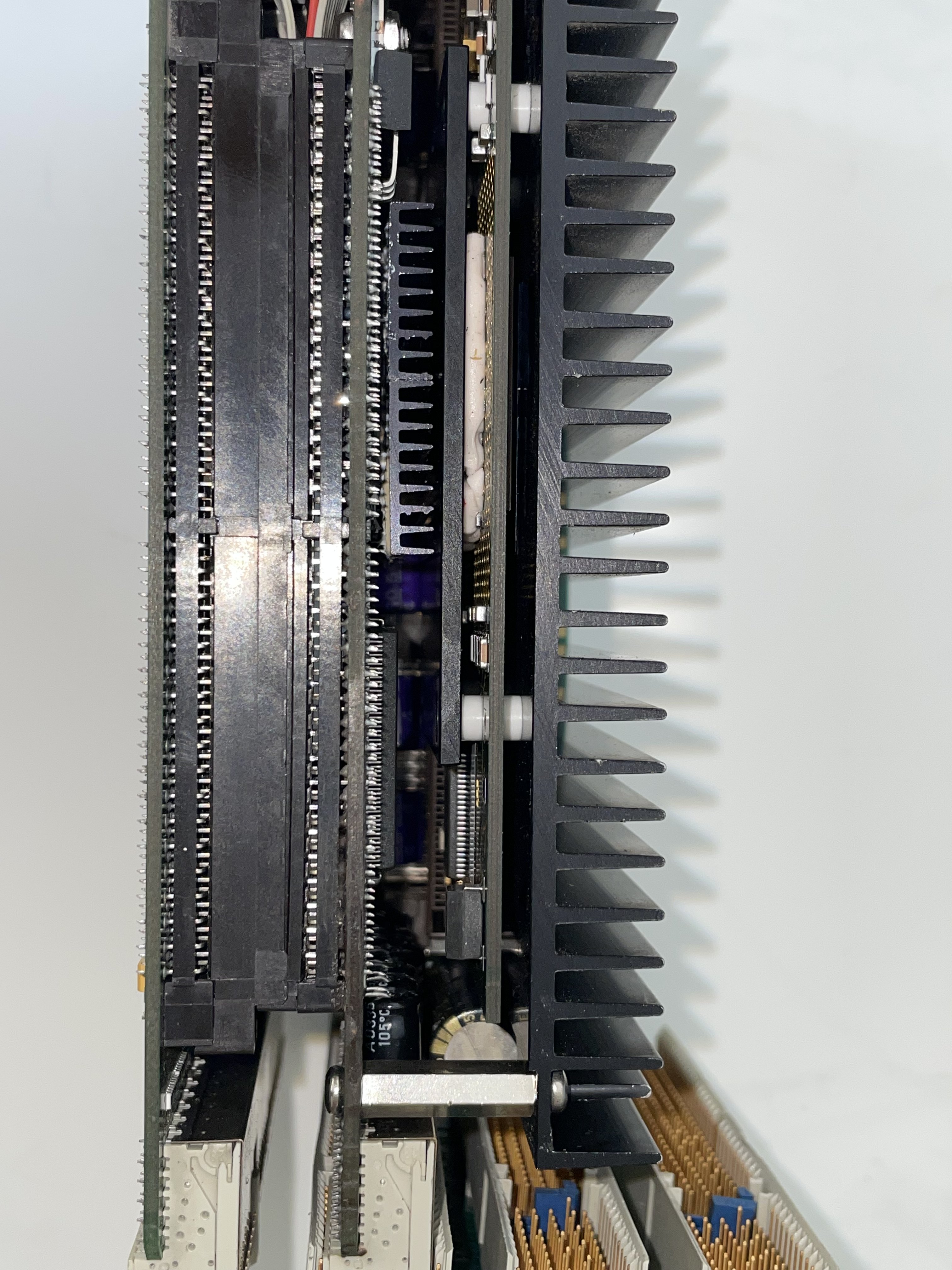
Taken out from the live environment due to the lab upgrade. Works good.
The Abaco CC7 (originally SBS Technologies CC7) is a single-slot C-size VXI module that functions as both a commander and servant on the VXIbus. It connects a host PC to a VXI chassis over MXI-2, giving you full message-based control of the backplane without needing an embedded controller in slot 0.
Key Specs
Form Factor: Single-slot, C-size VXI
VXI Role: Message-based Commander and Servant
Interface: MXI-2 (fiber or copper depending on configuration)
Bus: VXIbus, VME64 compatible
Slot: Slot 0 capable
Data Transfer: Up to 33MB/s over MXI-2
OS Support: Windows, with SBS/Abaco driver stack
Multi-chassis: Yes, supports multi-frame VXI topologies via MXI-2 daisy chain
Power Draw: Standard VXI C-size single slot
The CC7 installs in slot 0 of the VXI chassis and hands control to the host PC through the MXI-2 link. From the software side, the chassis instruments appear as addressable VXI devices on the bus, same as they would with any other slot 0 resource manager. VISA-compliant software talks to it without special handling.
Multi-chassis builds work through MXI-2 daisy chaining. The CC7 can serve as the primary commander in a multi-frame VXI topology, which is common in large ATE systems where one PC controls instruments spread across more than one mainframe.
The CC7 pairs with the CTM6 transition module on the host PC side. If you are moving from a CC7-based system to a newer Abaco module like the CL7, note that the CL7 uses the CTM15 transition module, which has a different pinout. They are not interchangeable without a cable change.
This unit was pulled from a working system, powered on, and verified at our Downingtown, PA facility before listing.
Does the CC7 require specific drivers?
Yes. The SBS/Abaco MXI-2 driver stack is required. Abaco has made legacy drivers available for Windows environments. We can confirm driver compatibility for your OS version before you order.
What transition module does the CC7 use?
The CTM6. This is the host-side interface card that pairs with the CC7 in the PC. If you are sourcing a CC7, make sure your host PC either already has a CTM6 installed or that you can source one. Without it, the MXI-2 link does not come up.
Is this the same as the SBS CC7?
Yes. Abaco Systems acquired SBS Technologies and the product line continued under the Abaco name. Same hardware, same firmware, documentation crosses over between both brands.
Multi-chassis support, how does that work?
You daisy chain additional VXI mainframes via MXI-2 cables from chassis to chassis. The CC7 in the first frame acts as the primary commander. Each subsequent frame needs a compatible servant module in slot 0. The host PC sees all frames as one logical VXI system.
Specifications
Parameter
Value
Data Transfer
Up to 33MB/s
Abaco CC7 — Repair & Calibration Service
Aumictech offers NIST-traceable calibration and repair for the Abaco CC7.
All calibrations are performed to NIST-traceable standards and ship with a certificate. Turnaround is typically 1–3 business days after receipt.
This Abaco CC7 is listed at $6,799. Calibration is available separately from $450. Contact us for volume pricing or if you need multiple units.
Abaco CC7 calibration cost
NIST-traceable calibration for the Abaco CC7 is $450 (standard — pass/fail certificate and calibration sticker) or $650 (full measured data at every test point, reference standards documented, traceability chain included). Turnaround is 1 to 3 business days after receipt. See full calibration details →
This product compared with
Compare with another product
Start typing to search in-stock inventory.
Added to cart
Ready to check out, or keep browsing the inventory?