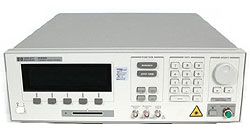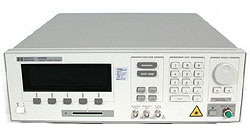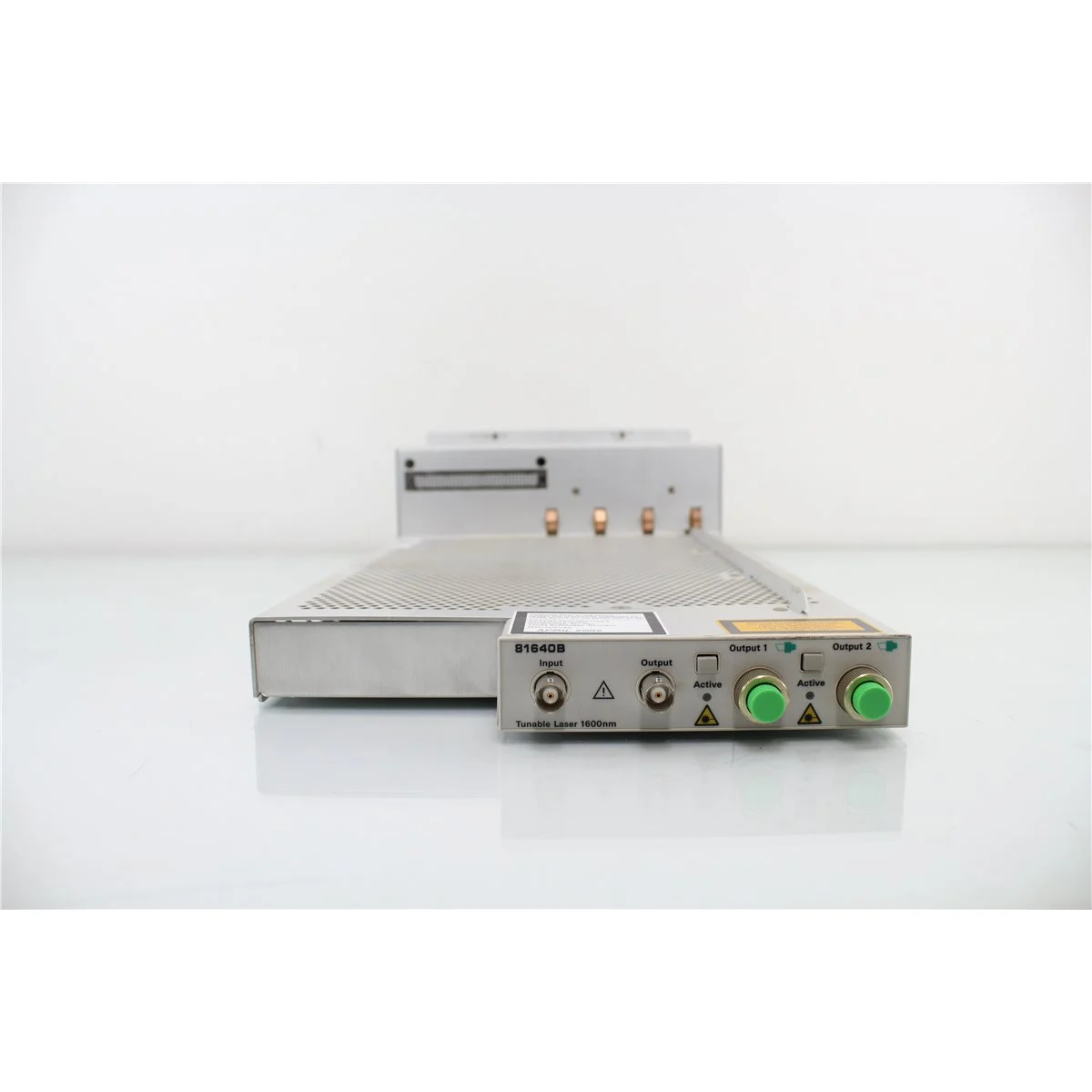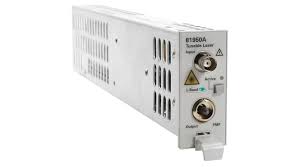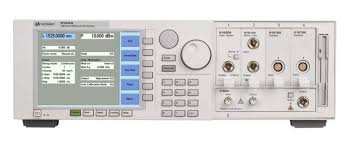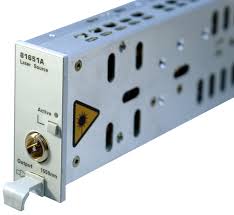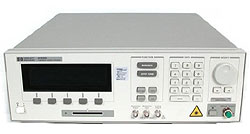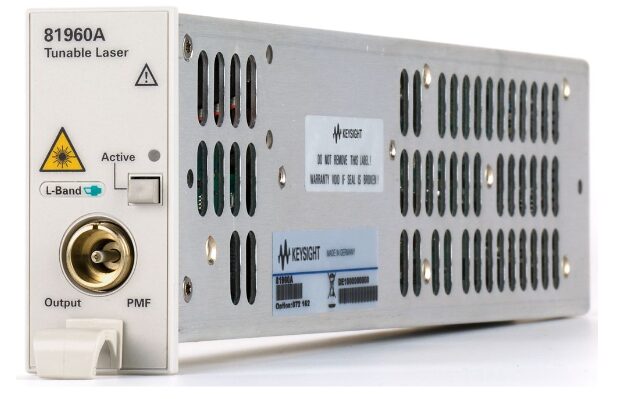
Agilent 81600B Tunable Laser Source with option 071/ 132(1260 nm ~ 1375 nm)
The Agilent Keysight 81600B is the widest-range, lowest-SSE tunable laser source built for the 8164B Lightwave Measurement System mainframe. Mode-hop-free tuning, continuous output power, a built-in wavelength meter and attenuator, and full coverage from 1260 nm to 1640 nm with no wavelength gaps.
- Model
- HP / Agilent 81600B
- Calibration
- NIST-traceable · 2027-12-31
- Price
- $28,138
- Status
- In stock
- RFQ ref
- 81600B
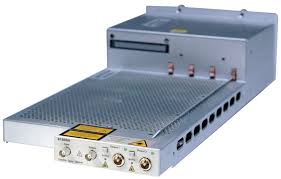
This unit
Calibrated unit. With option 071/132 (1260 nm ~ 1375 nm).
Verification before listing:
- OEM and NIST-traceable calibration performed.
What sets the 81600B apart from cheaper tunable lasers is the combination of low SSE, a built-in wavelength meter, and a built-in optical attenuator with 60 dB of range on equipped modules. The low SSE is the part that matters most for filter work. It typically allows crosstalk measurements better than 70 dB on an 8-channel CWDM multiplexer, which a noisier source simply can't do. If you are running stimulus-response testing on optical filters, this is the source that gives you the dynamic range.
The 81600B family consists of seven modules. The option number tells you the band and whether it is the low-SSE or high-power version:
Option 130: 1260 to 1375 nm, O-band, low SSE
Option 132: 1260 to 1375 nm, O-band, high power
Option 140: 1370 to 1495 nm, low SSE
Option 142: 1370 to 1495 nm, high power (built-in attenuator available, Option 003)
Option 150: 1450 to 1590 nm, low SSE
Option 160: 1495 to 1640 nm, low SSE
Option 200: 1440 to 1640 nm, all-band, low SSE
Option 201: 1455 to 1640 nm, all-band, low SSE
The O-band options, 130 and 132, are the ones people struggle to find. Option 130 is the low-SSE version, and it is the right tool for testing wavelength filters on 100GBASE-LR4 components and for silicon photonics device work, where the O-band matters and low SSE is what lets you see the deep features. Option 132 is the high-power version for stimulus-response tests that need more output. Both use PMF output and both fit the 8164B. If you are doing O-band work and need a tunable laser for it, this is the module, and they do not come up often.
The 81600B uses polarization-maintaining Panda-type output fiber. Option 071 is straight contact, Option 072 is angled contact. Angled connectors help control return loss by reducing back reflection, which matters when you are measuring anything sensitive to multi-path interference.
Specifications
- Wavelength range: 1260 nm to 1640 nm across the family, no gaps
- Tuning: mode-hop-free, continuous output power
- Relative wavelength accuracy: typ. ±3.6 pm
- Absolute wavelength accuracy specified in both continuous sweep and stepped modes
- Optical power stability: typ. ±0.03 dB over 24 hours
- SSE: low SSE output enabling greater than 70 dB crosstalk measurement on an 8-channel CWDM multiplexer
- Built-in optical attenuator: 60 dB range on equipped modules
- Built-in wavelength meter for tuning precision
Coherence control unit to reduce interference effects from the DUT
Output fiber: polarization-maintaining Panda-type; Option 071 straight, Option 072 angled
Mainframe: Agilent Keysight 8164B Lightwave Measurement System, bottom slot
Laser class: Class 1M per IEC 60825-1
Software: supported by the N7700A software suite for insertion loss and PDL spectral measurements
Applications
DWDM and CWDM component testing. Passive optical network (PON) component characterization. Optical filter insertion loss and PDL measurement, usually paired with a power sensor module. Silicon photonics device characterization, especially with the O-band options. Fiber Bragg grating measurement using the low-SSE output. Anywhere you need a source that sweeps fast, sweeps accurately, and stays quiet.
Repair and calibration
Aumictech Labs repairs and calibrates the 81600B in-house. These are precision instruments and they drift. When a wavelength reads wrong, the power goes unstable, or a unit that should be mode-hop-free starts hopping, that is a repair, not a reason to scrap a module worth real money.
Common issues we service:
Wavelength reads off or fails against a wavemeter, from control-loop drift or reference aging
Output power low or unstable, from an aging laser, attenuator drift, or a contaminated optical path
Mode hops on a unit rated mode-hop-free, from cavity or temperature-control drift
Module not recognized by the 8164B mainframe, from connector wear or firmware mismatch
High SSE and poor dynamic range on filter sweeps
Worn or damaged PMF output connector
Every serviced 81600B is recalibrated against traceable references and ships with a NIST-traceable certificate covering wavelength accuracy, output power, and SSE across the tuning range. Free evaluation first, flat-rate quote before any work.
Specifications
| Parameter | Value |
|---|---|
| Wavelength range | 1260 nm to 1640 nm across the family, no gaps |
| Relative wavelength accuracy | typ. ±3.6 pm |
| Optical power stability | typ. ±0.03 dB over 24 hours |
| Built-in optical attenuator | 60 dB range on equipped modules |
Frequently Asked Questions
- What wavelength range does the Agilent 81600B cover?
- The family covers 1260 nm to 1640 nm with no gaps, depending on the option. O-band models (130 and 132) cover 1260 to 1375 nm. All-band models (200 and 201) cover 1440 to 1640 nm and 1455 to 1640 nm. Seven modules in total, each covering a defined band.
- Which 81600B option covers the O-band?
- Options 130 and 132, both covering 1260 to 1375 nm. Option 130 is low SSE, ideal for LR4 filter testing and silicon photonics. Option 132 is the high-power version for stimulus-response tests. Both use PMF output and fit the 8164B.
- Is the 81600B mode-hop-free?
- Yes. It is mode-hop-free with continuous output power and a built-in wavelength control loop, which is why it qualifies for testing the most critical DWDM components. Mode hops mean a cavity or temperature-control fault, which we repair and recalibrate.
- Does the 81600B need the 8164B mainframe?
- Yes. All 81600B modules fit the bottom slot of the 8164B Lightwave Measurement System. The module does not run standalone. We can supply the module, the mainframe, or both.
- What is SSE and why does it matter?
- SSE is source spontaneous emission. The 81600B is a low-SSE laser, which lets it measure filters with high dynamic range, better than 70 dB crosstalk on an 8-channel CWDM mux. If SSE has degraded, dynamic range suffers, and we can measure and restore it.
HP / Agilent 81600B — Repair & Calibration Service
Aumictech offers NIST-traceable calibration and repair for the HP / Agilent 81600B. Calibration covers wavelength accuracy at 5 or more points across the full tuning range, mode-hop-free range, output power flatness, linewidth, and side-mode suppression ratio (SMSR). All calibrations ship with a NIST-traceable certificate. Turnaround is typically 1–3 business days after receipt.
Common HP / Agilent 81600B faults: output power drift, mode hops, fiber pigtail connector damage, wavelength inaccuracy. Common faults include output power drift after extended use, mode hops at specific wavelengths, and fiber pigtail connector damage. Full alignment and piezo calibration typically restore performance to spec.
HP / Agilent 81600B price
This HP / Agilent 81600B is listed at $28,138. NIST-traceable calibration is included with this unit. Contact us for volume pricing or if you need multiple units.
HP / Agilent 81600B calibration cost
NIST-traceable calibration for the HP / Agilent 81600B is $450 (standard — pass/fail certificate and calibration sticker) or $650 (full measured data at every test point, reference standards documented, traceability chain included). Calibration for this instrument covers wavelength accuracy at 5 or more points across the full tuning range, mode-hop-free range, output power flatness, linewidth, and side-mode suppression ratio (SMSR). Turnaround is 1 to 3 business days after receipt. See full calibration details →