
Agilent 81600B Tunable Laser Source repair, calibration, and troubleshooting
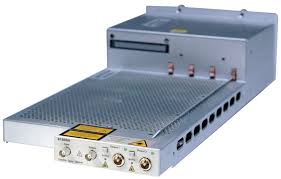
The Agilent 81600B is the tunable laser module that sits in the bottom slot of an 8164B Lightwave Measurement System mainframe. Mode-hop-free, low SSE, built-in wavelength meter, 60 dB built-in attenuator, covering 1260 nm to 1640 nm across the family with no wavelength gaps. It's the source that shows up wherever DWDM, CWDM, PON, silicon photonics, or filter dynamic range work is happening.
It's also the source that ends up on our bench most often when a lab's wavelength readings drift, when output power gets flaky, when the module suddenly won't be seen by the 8164B, or when a unit that's supposed to be mode-hop-free starts hopping. All of that is fixable. Aumictech Labs repairs and calibrates the 81600B in house across every option, including the O-band 130 and 132, and every certificate ships with the actual measured data, not a two-page summary.
We have Agilent 81600B modules in stock, including an Option 132 (1260 nm to 1375 nm, high power). If yours is out of service and it makes more sense to swap than to repair, we can quote both.
The 81600B options in one place
Every 81600B option, the wavelength band, and what it's really for.
| Option | Wavelength range | Notes |
|---|---|---|
| 130 | 1260 to 1375 nm | O-band, low SSE. LR4 filter testing, silicon photonics |
| 132 | 1260 to 1375 nm | O-band, high power |
| 140 | 1370 to 1495 nm | E/S-band, low SSE |
| 142 | 1370 to 1495 nm | E/S-band, high power (Option 003 attenuator available) |
| 150 | 1450 to 1590 nm | S/C-band, low SSE |
| 160 | 1495 to 1640 nm | C/L-band, low SSE |
| 200 | 1440 to 1640 nm | All-band, low SSE |
| 201 | 1455 to 1640 nm | All-band, low SSE |
Connector options are Option 071 (PMF, straight contact) and Option 072 (PMF, angled contact). Angled contact is the one people should be running for anything sensitive to return loss, which is basically everything the 81600B gets used for.
The problems we actually see, and what they mean
When customers ship an 81600B in, it's almost always for one of these. Wording differs by test setup, but the underlying causes are consistent.
Wavelength reading is drifting or fails against a wavemeter. This is the number one call. The 81600B has a built-in wavelength control loop, and that loop drifts with time and use. Reference sources age. Sometimes the module just needs a proper recalibration. Sometimes the control loop itself is out of spec and needs bench work. Either way, we verify against a traceable reference and bring the module back into wavelength accuracy across its full range.
Output power is low, unstable, or drifting. Aging laser, drifted internal attenuator (the 60 dB one on equipped modules can wander on its own), or contamination in the optical path. Environmental swings will do it too. We recalibrate output power, service the attenuator, clean the optical path, and verify power flatness across the band.
Mode hops on a module that's supposed to be mode-hop-free. The 81600B qualifies for the most critical DWDM component testing because it's continuously tunable with no mode hops. When it starts hopping, that's cavity or temperature-control drift. It's not a settings issue and no amount of firmware fiddling fixes it. It's a bench repair.
Module isn't recognized by the 8164B, or comes and goes. Connector wear at the mainframe-to-module interface, firmware mismatch, or a controller-side fault. Sometimes it's the mainframe, not the module. We service both and can advise which side is at fault before you spend money on the wrong thing.
High SSE, poor dynamic range on filter sweeps. The low-SSE performance is what lets the 81600B measure crosstalk better than 70 dB on an 8-channel CWDM mux. When SSE degrades, that dynamic range collapses and your filter measurements suffer. We measure SSE ratio, correct it where we can, and re-certify low-SSE performance with actual data.
Damaged, worn, or contaminated PMF output connector. The angled contact interface (Option 072) is more forgiving than straight, but nothing survives forever. We replace the connector interface, clean or replace ferrules, and verify return loss before it ships back.
If your symptom isn't on this list, send us what you're seeing. Nine times out of ten we've seen it before.
What our 81600B calibration actually includes
A calibration certificate for an instrument this expensive should not be a two-page summary. Ours isn't. Every 81600B goes through the same process:
Full wavelength accuracy verification across the full tuning range of your option, against a traceable wavemeter reference. Output power calibration and power flatness across the band. Mode-hop-free continuous sweep verification. Effective linewidth check with coherence control on and off, where the option supports it. SSE ratio measurement on low-SSE modules. Internal attenuator calibration on modules equipped with the 60 dB attenuator. Absolute wavelength accuracy in both continuous sweep and stepped modes. Long-term power stability check.
The certificate you get back includes the actual measured data at each point, before and after where the unit needed repair, the reference standards used, and the traceability chain. NIST-traceable. Printed or PDF, whichever you need for your audit paperwork.
Repair process, and what it costs
Nothing is a surprise. Here's how it works.
You send us the module. We evaluate it at no charge and diagnose what it needs. Within one to two business days we send you a written diagnosis and a flat-rate quote for whatever the fix is. If you approve it, we do the work and recalibrate. If you don't, you cover return shipping and that's it. We don't do "we'll get in there and see" pricing. Flat rate up front, so you can decide with the number in front of you.
Turnaround is a few business days from approval on most repairs. Rush service is available if you're in a bind, tell us when you need it back and we'll confirm whether we can hit it.
Service specifications
| Parameter | Value |
|---|---|
| Wavelength range | 1440 nm to 1640 nm |
| Output power | Up to +13 dBm |
| Mainframe | Agilent 8164A/B or 8166A/B |
Frequently asked questions
Do you calibrate every option, including the O-band 130 and 132?
My 81600B has drifted. Is it a repair or just a calibration?
Documents
Also in inventory - buy a tested unit
We also sell refurbished Agilent 81600B units that have been verified and are ready to ship.