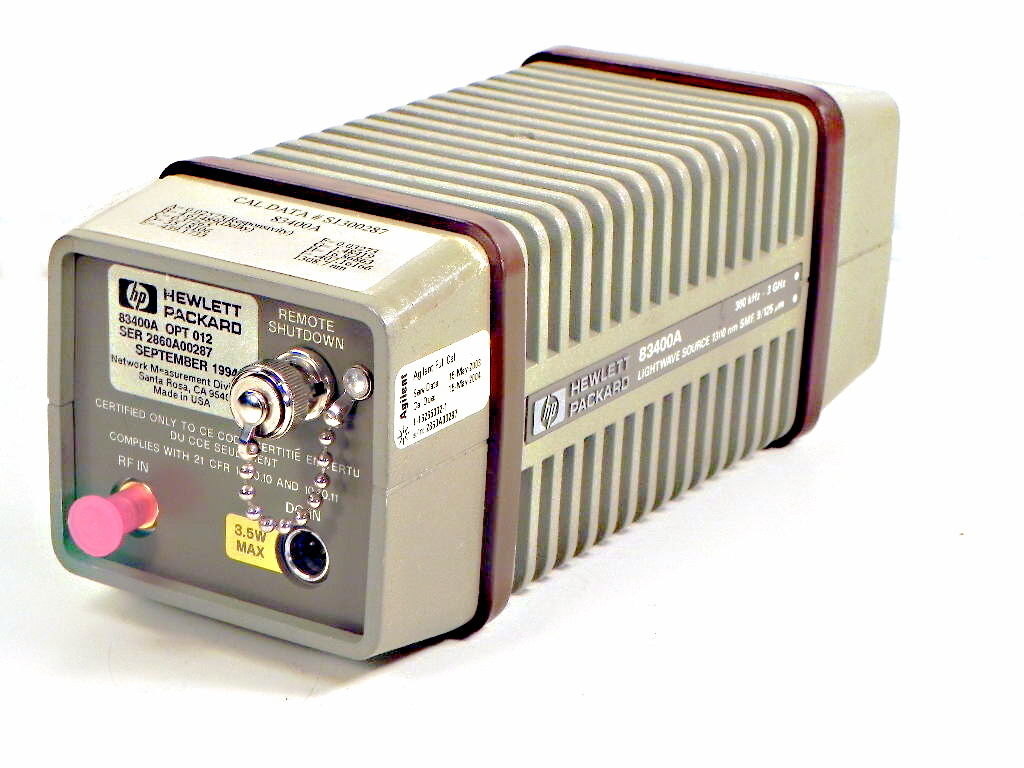
Agilent/Keysight 83430A Lightwave Source
The Agilent/Keysight 83430A is a broadband lightwave receiver designed for optical component and system testing. It operates in the 1200-1600 nm wavelength range and has a bandwidth of up to 30 GHz. This receiver is used for accurate measurement of optical signals in various applications.
- Model
- Agilent / Keysight 83430A
- Calibration
- Available on request
- Price · starting from
- $2,519
- Status
- In stock
- RFQ ref
- 83430A
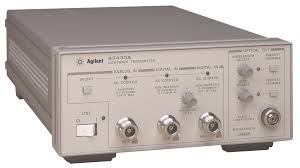
This unit
The Agilent/Keysight 83430A is a directly modulated DFB lightwave source engineered for high-speed optical receiver and system characterization. It delivers SDH/SONET-compliant digital and analog modulation across data rates from OC-1 (52 Mb/s) to OC-48/STM-16 (2.488 Gb/s), supporting TDM and WDM test applications. The 83430A functions as both a standalone optical source and as a core instrument in integrated test benches for sensitivity analysis, dispersion measurement, and transceiver waveform validation.
Technical Specifications
- Laser Type: DFB directly modulated
- Wavelength: 1309.0 nm and 1309.6 nm; user-selectable with ±1.25 nm adjustment or ±1 nm center wavelength
- Data Rate Support: 52 Mb/s (OC-1), 155 Mb/s (OC-3/STM-1), 622 Mb/s (OC-12/STM-4), 2.488 Gb/s (OC-48/STM-16)
- Optical Output Power: 1.35 mW average (AC digital In); 0.7 mW average (Analog In); +8.1 dBm maximum (6.5 mW)
- Modulation Bandwidth: Up to 1.3 GHz (AC digital In); up to 70 MHz (Analog In)
- Modulation Inputs: Analog In (AC coupled), Digital In (AC coupled), Digital In (DC coupled)
- Extinction Ratio: User adjustable
- Laser Classification: IEC Class 1
- Optical Interface: FC/PC (standard Agilent interface)
Key Features
- Directly modulated architecture minimizes setup complexity for standard optical testing
- Adjustable extinction ratio enables optimization for receiver sensitivity and jitter tolerance measurements
- Multiple modulation input configurations support both digital and analog test signals
- User-selectable wavelengths with fine adjustment capability accommodate fiber and component variations
Typical Applications
- Optical receiver sensitivity and power penalty characterization
- Dispersion testing on single-mode fiber links
- Transceiver waveform analysis including filtered conformance masks and eye diagrams
- Jitter tolerance assessment of high-speed receivers
- Digital, WDM, and analog signal validation up to 2.5 Gb/s
Compatibility & Integration The 83430A integrates with Agilent/Keysight measurement systems including the 71603A Error Performance Analyzer, 83446A Lightwave Clock/Data Receiver, and 83480A Digital Communications Analyzer for end-to-end optical system characterization.
Agilent / Keysight 83430A — Repair & Calibration Service
Aumictech offers NIST-traceable calibration and repair for the Agilent / Keysight 83430A. Calibration covers output power at specified wavelengths, wavelength accuracy, 15-minute output stability, and modulation frequency accuracy where applicable. All calibrations ship with a NIST-traceable certificate. Turnaround is typically 1–3 business days after receipt.
Common Agilent / Keysight 83430A faults: laser diode end-of-life (output below spec), fiber output connector damage, output instability. Common repairs include laser diode replacement when output falls below spec, fiber output connector repair, and thermal management service.
Agilent / Keysight 83430A price
This Agilent / Keysight 83430A is listed at $2,519. Calibration is available separately from $450. Contact us for volume pricing or if you need multiple units.
Agilent / Keysight 83430A calibration cost
NIST-traceable calibration for the Agilent / Keysight 83430A is $450 (standard — pass/fail certificate and calibration sticker) or $650 (full measured data at every test point, reference standards documented, traceability chain included). Calibration for this instrument covers output power at specified wavelengths, wavelength accuracy, 15-minute output stability, and modulation frequency accuracy where applicable. Turnaround is 1 to 3 business days after receipt. See full calibration details →