Stanford Research SR542 Precision Optical Chopper
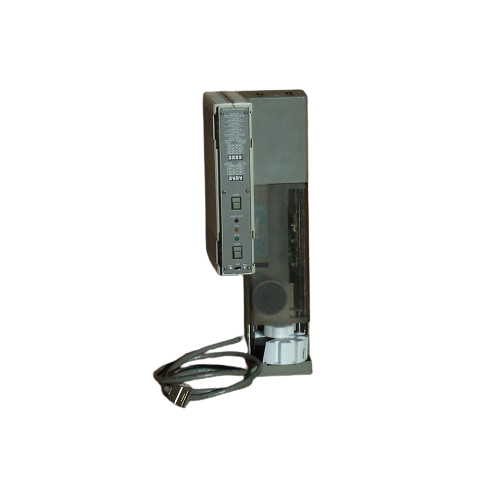
The Stanford Research Systems SR542 Precision Optical Chopper is a versatile instrument used to modulate light beams in various optical experiments. It offers precise frequency control and stable operation, making it suitable for demanding scientific applications.
- Model
- Stanford Research Systems SR542
- Calibration
- Available on request
- Price · starting from
- $1,179
- Status
- In stock
- RFQ ref
- SR542
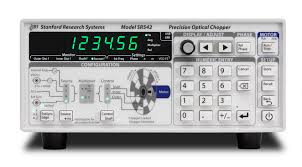
This unit
The Stanford Research Systems SR542 Precision Optical Chopper modulates light beams with high frequency stability and low phase jitter for demanding spectroscopy, interferometry, and optical sensing applications. Built around a slotless brushless DC motor and precision photo-etched chopper blades, the SR542 delivers repeatable performance across a wide operating range with user-programmable harmonic and sub-harmonic control. Its analog current amplifier eliminates high-frequency EMI while six rear-panel reference outputs enable synchronization of cascading choppers and external instruments via USB or multiple synchronization sources.
Technical Specifications
- Frequency Range: 0.4 Hz to 20 kHz (blade-dependent)
- Frequency Accuracy: 20 ppm (0.002%)
- Phase Resolution: 0.01°
- Phase Jitter: 0.4° to 1.1° rms depending on operating frequency
- Chopper Blades: Precision photo-etched blackened stainless steel; 4-inch outer diameter, 0.010-inch thickness
- Blade Options: Single frequency, dual frequency, and variable duty factor designs
- Motor: Slotless brushless DC motor with low mechanical vibration
- Synchronization Sources: External frequency reference (sine or TTL/CMOS), internal crystal oscillator, VCO input (0 to +10 VDC), AC line (50 Hz to 60 Hz)
- Frequency Control: User-programmable multiplier/divider for harmonic, sub-harmonic, or fractional harmonic operation
- Phase Control: 0.01° resolution with adjustable offset; zero-phase reference capability
- Shutter Mode: Operates as optical shutter via phase setting at 0 Hz internal frequency
Key Features
- Analog 3-phase sinusoidal motor drive eliminates PWM-related EMI
- Brushless motor design minimizes wear and extends operating life
- Removable shroud prevents accidental contact with rotating head
- Flexible mounting to 1-inch optical breadboard (2-inch slot spacing) or 0.5-inch optical post
- Six rear-panel BNC reference outputs for instrument cascading and external triggering
Interfaces
- USB computer control with 115,200 baud serial port emulation
- Two BNC inputs; six BNC outputs
- Direct integration with multi-instrument optical systems
Specifications
| Parameter | Value |
|---|---|
| Frequency Range | 0.4 Hz to 20 kHz | Voltage / Current Range: VCO input 0 to +10 VDC |
Stanford Research Systems SR542 — Repair & Calibration Service
Aumictech offers NIST-traceable calibration and repair for the Stanford Research Systems SR542. Calibration covers calibration scope varies by instrument type: vacuum gauges are verified at multiple pressure points against NIST-traceable pressure standards; spectrophotometers at wavelength accuracy and photometric accuracy points; strain gauge indicators at bridge excitation accuracy and full-scale output accuracy; pH meters against certified buffer solutions at pH 4, 7, and 10.. All calibrations ship with a NIST-traceable certificate. Turnaround is typically 1–3 business days after receipt.
Common Stanford Research Systems SR542 faults: vacuum gauge filament failure (ionization gauges), spectrophotometer D2 lamp end-of-life, wavelength motor failure, strain indicator front-panel binding post corrosion, pH electrode conditioning failure. Most specialty laboratory instruments fail at their electromechanical interfaces first — vacuum gauge connectors and filament assemblies, spectrophotometer lamp housings and motor drives, strain indicator binding post corrosion. Component-level repair is standard; manufacturer support for legacy instruments is often limited, making third-party bench repair the practical path.
Stanford Research Systems SR542 price
This Stanford Research Systems SR542 is listed at $1,179. Calibration is available separately from $450. Contact us for volume pricing or if you need multiple units.
Stanford Research Systems SR542 calibration cost
NIST-traceable calibration for the Stanford Research Systems SR542 is $450 (standard — pass/fail certificate and calibration sticker) or $650 (full measured data at every test point, reference standards documented, traceability chain included). Calibration for this instrument covers calibration scope varies by instrument type: vacuum gauges are verified at multiple pressure points against NIST-traceable pressure standards; spectrophotometers at wavelength accuracy and photometric accuracy points; strain gauge indicators at bridge excitation accuracy and full-scale output accuracy; pH meters against certified buffer solutions at pH 4, 7, and 10.. Turnaround is 1 to 3 business days after receipt. See full calibration details →