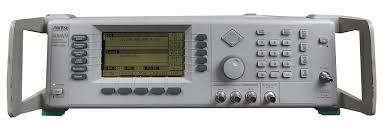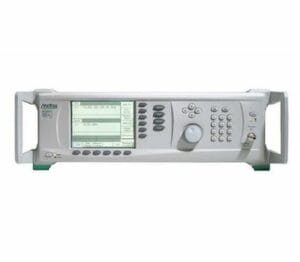
Stanford Research CG644 – PECL (+3.3Vcc) up to 2050MHz
Stanford Research Systems Signal Generators. Frequency Range: DC to 2050 MHz, Resolution: 16 digits.
- Model
- Stanford Research Systems CG644
- Calibration
- Available on request
- Price · starting from
- $450
- Status
- In stock
- RFQ ref
- CG644
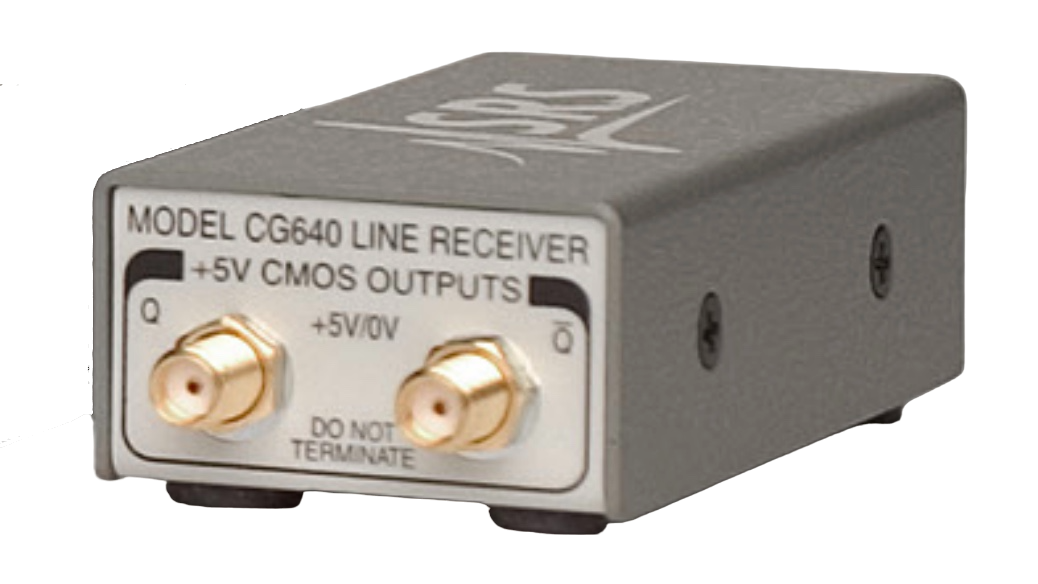
This unit
The Stanford Research Systems CG644 is a programmable PECL clock generator delivering stable, low-jitter signals up to 2050 MHz. Built on the proven CG635 Synthesized Clock Generator platform, it combines precise frequency control with fast transition times and exceptional timebase stability, making it ideal for high-speed digital system synchronization, test automation, and laboratory signal generation.
Technical Specifications
- Frequency Range: DC to 2050 MHz
- Output Type: PECL (+3.3Vcc)
- Jitter (rms): <1 ps rms
- Transition Time (Rise/Fall): Typically 80 ps (20% to 80%)
- Frequency Resolution: 16 digits
- Output Impedance: 50 Ω (front-panel outputs); 100 Ω differential (rear-panel outputs)
- Load Impedance: 50 Ω (front-panel); 100 Ω differential (rear-panel)
- Timebase Stability: Better than 5 ppm (crystal standard); optional OCXO and Rubidium timebases available
- Power Supply: +3.3Vcc for PECL outputs; universal AC input worldwide; +5 V and -5 V accessory power on rear panel
Key Features
- Complementary Q and -Q front-panel outputs for differential signaling
- Rear-panel RJ-45 connector supporting LVDS differential outputs to 2.05 GHz and RS-485 levels to 105 MHz
- CAT-6 cable compatible with 100 Ω terminations
- 10 MHz reference input and output
- Phase and time modulation inputs
- GPIB and RS-232 remote control interfaces
Typical Applications
- High-speed digital system clocking and synchronization
- Test and measurement equipment timing
- Data acquisition system synchronization
- RF and microwave instrumentation
- Laboratory clock generation
Compatibility & Integration The CG644 integrates with standard 50 Ω and 100 Ω differential test infrastructure. Remote programming via GPIB or RS-232 enables seamless automation in ATE and laboratory environments. Optional precision timebases extend stability for demanding metrology applications.
Specifications
| Parameter | Value |
|---|---|
| Frequency Range | DC to 2050 MHz | Voltage / Current Range: '+3.3Vcc (PECL output) |
Stanford Research Systems CG644 — Repair & Calibration Service
Aumictech offers NIST-traceable calibration and repair for the Stanford Research Systems CG644. Calibration covers output frequency accuracy, output power level accuracy across the full frequency range, AM/FM/PM/pulse modulation accuracy, harmonic and spurious output levels, and phase noise floor verification. All calibrations ship with a NIST-traceable certificate. Turnaround is typically 1–3 business days after receipt.
Common Stanford Research Systems CG644 faults: YIG oscillator failure (no output or loss of lock), step attenuator wear (output drops or steps at set attenuation), ALC loop failure (uncontrolled output power), I/Q modulator assembly failure. HP/Agilent 836xx series most common faults are YIG oscillator failure and step attenuator contact wear causing output steps or drops at specific attenuation settings. Keysight E4428C/E4438C units most commonly develop ALC loop failure and I/Q modulator assembly faults. YIG oscillator replacement and attenuator service are stocked repairs.
Stanford Research Systems CG644 price
This Stanford Research Systems CG644 is listed at $450. Calibration is available separately from $450. Contact us for volume pricing or if you need multiple units.
Stanford Research Systems CG644 calibration cost
NIST-traceable calibration for the Stanford Research Systems CG644 is $450 (standard — pass/fail certificate and calibration sticker) or $650 (full measured data at every test point, reference standards documented, traceability chain included). Calibration for this instrument covers output frequency accuracy, output power level accuracy across the full frequency range, AM/FM/PM/pulse modulation accuracy, harmonic and spurious output levels, and phase noise floor verification. Turnaround is 1 to 3 business days after receipt. See full calibration details →