
What the 1261B actually is
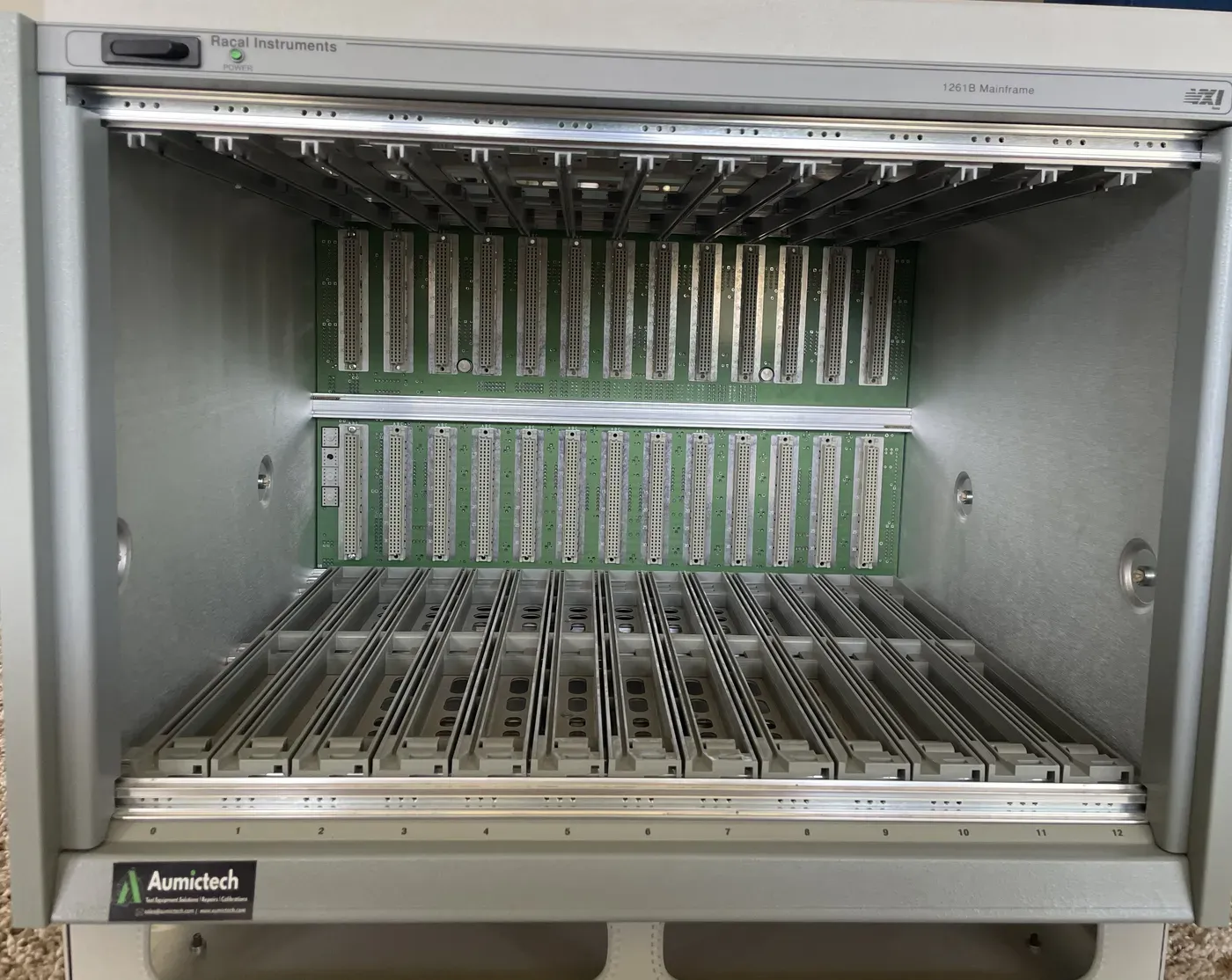
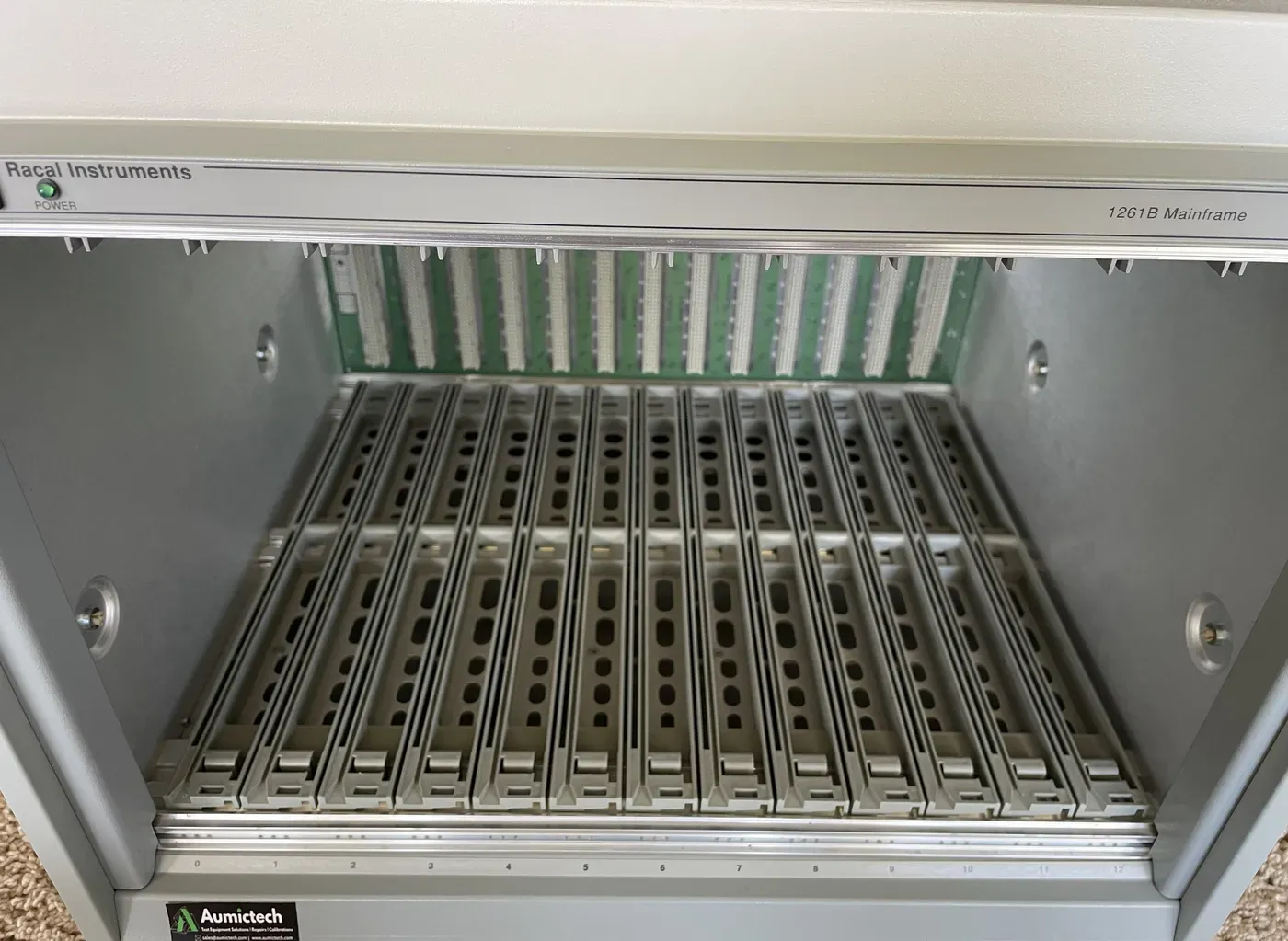
The 1261B is a 13-slot C-size VXIbus mainframe built by Racal Instruments. The product line sits under Astronics Test Systems now, and it passed through EADS North America on the way, so you'll see all three names on labels and paperwork depending on vintage. It's fully compliant with the VXIbus specification and VXIplug&play compatible. Slots run 0 through 12.
Racal called it a fourth-generation design, and it shows. This isn't an early, marginal VXI frame. It was built to deliver more power and more cooling than any other general-purpose VXI mainframe in its class, which is how it ended up in so many defense and aerospace test stations where downtime isn't an option.
It comes in two heights. The 7U is the benchtop unit, good where space is tight, pulling air from the rear and exhausting out the top. The 9U is built for rack mounting, draws air from the sides and exhausts out the rear to dodge rack chimney effects, and ships with a 2.25 inch cable tray. Racking it? Get the 9U. Bench work? The 7U saves you space.
The backplane and the signals that matter
A lot of the quiet engineering lives in the backplane. It's solid-state, with auto-configuring jumperless BUS GRANT and IACK daisy chaining. On older frames you set daisy-chain jumpers every time you rearranged cards. Not here. Move a card and the backplane sorts the chain out itself, which saves real time and kills off a whole category of setup mistakes.
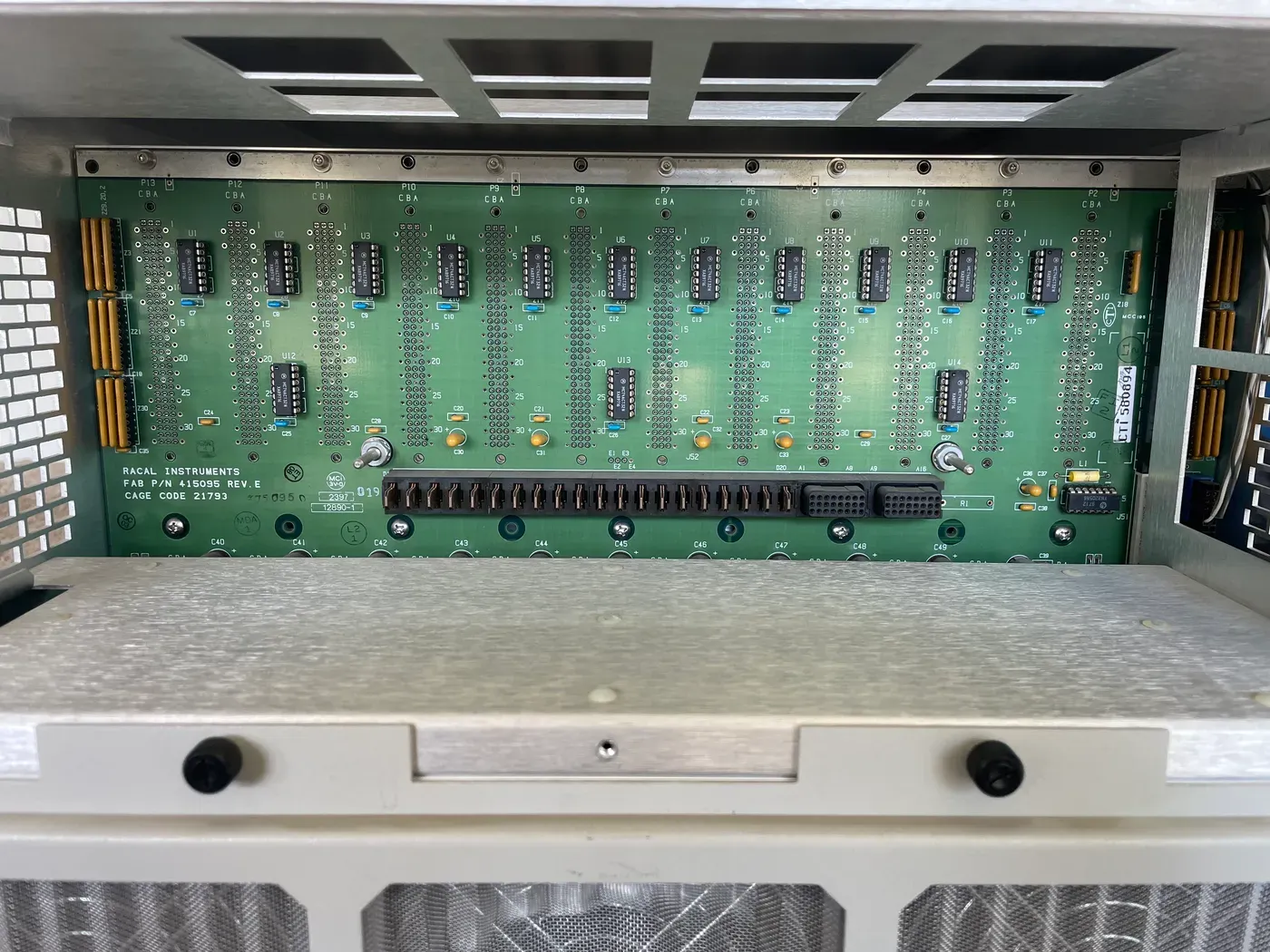
CLK10, the 10 MHz VXI system clock, is distributed fully differentially, which keeps timing clean across the frame. ACFAIL and SYSRESET are handled in full compliance with the VMEbus and VXIbus specs. Eight TTL trigger lines run on the bus, and those matter a great deal once you start synchronizing measurements across modules. The monitoring options can route them to and from the rear panel, which I'll come back to.
There's also a quick-check diagnostic connector that brings out all seven VXI rail voltages, all seven rail currents, and ACFAIL, INHIBIT and SYSRESET. When something misbehaves, that connector is the first place I go with a meter.
Power delivery, rail by rail
At 230 VAC the 1261B delivers 925 watts to the slots across 0 to 40 C, and 1025 watts if you keep it between 0 and 30 C. The supply plugs straight into the backplane instead of running through a wiring harness, so you lose less and get cleaner delivery with low ripple and noise. High dynamic current on the rails is what keeps waveforms crisp when a module suddenly demands current.
Here's the available current per rail. IMP is the steady maximum, IMD is what the rail can supply to fast-changing loads.
| Rail | Peak (IMP) | Dynamic (IMD) |
|---|---|---|
| +5 V | 80 A | 15 A |
| +12 V | 17 A | 3 A |
| -12 V | 17 A | 3 A |
| +24 V | 12 A | 6.5 A |
| -24 V | 12 A | 6.5 A |
| -5.2 V | 60 A | 9 A |
| -2 V | 30 A | 4.5 A |
The input auto-ranges on both voltage and frequency: 90 to 250 VAC, 45 to 66 Hz at 230 VAC, and 45 to 440 Hz at 120 VAC. No voltage selector switch to set, which is one less thing to get wrong when a chassis moves between sites or onto 400 Hz aircraft-style power. Inrush hits 70 A maximum, so size your upstream protection for it.
Every rail is protected against over-voltage, under-voltage, over-current, under-current, over-temperature, short to ground, and short between rails. That protection is a big reason these frames survive decades of module swaps by people who don't always check what they're plugging in.
Cooling, the feature that keeps modules alive
Racal built a pressurized plenum so air distributes evenly front to back and side to side instead of going wherever it likes. Molded card guides push airflow through the installed modules rather than letting it slip between them. Snap-on covers and airflow blockers seal off empty slots so you don't lose pressure where there's no card.
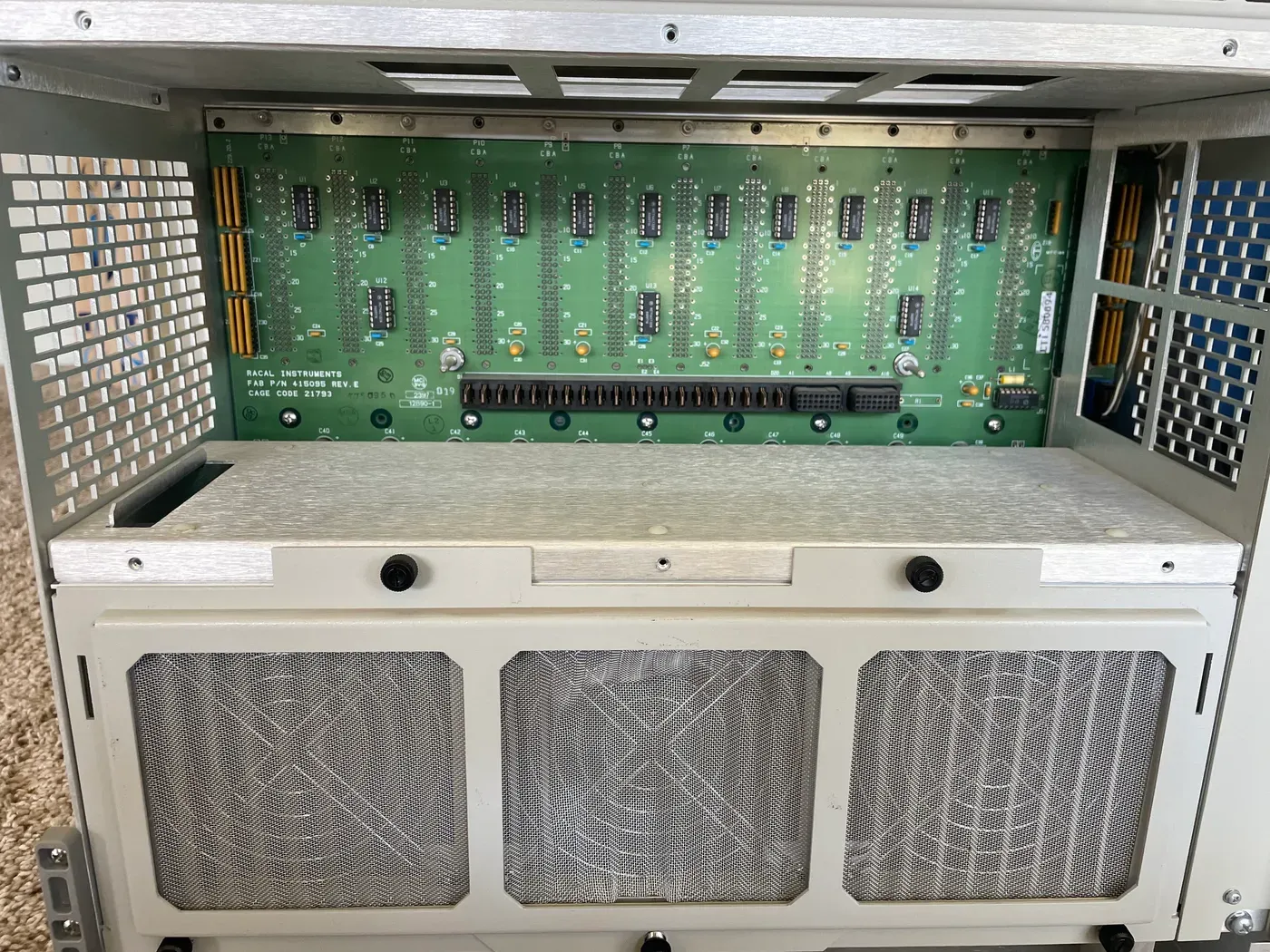
The three-fan rear assembly is the fault-tolerant part. Lose one fan and the other two keep cooling at a high level, protecting your module investment until you swap the dead one. The whole assembly is rear-pluggable and out in under five minutes. So are the power supply, the air filters, and the monitor module. Fast mean time to repair was designed in, not bolted on afterward.
Basic units get a HI/LO switch to trade acoustic noise against cooling. Units with a monitor add variable-speed cooling that ramps fan speed off the worst slot temperature rise, so you get quiet during development and full cooling when a fielded system needs it. A basic unit runs 56 dBA on LO and 62 on HI. Monitored units get down to 52 dBA in their quieter mode.
Basic, SMS, or EMS
The 1261B ships in three flavors, and this is what trips people up buying used. Know which one you're looking at before you pay.
Basic
You get the HI/LO cooling switch and the quick-check diagnostic connector. That's your monitoring. No LEDs telling you a rail drooped, no temperature readout. Fine if you monitor conditions elsewhere or you just need a solid frame.
Standard Monitor System (SMS)
Adds bi-color red and green LED annunciators on the front for voltage, current, temperature and airflow, plus analog monitor outputs: a current monitor at 5 V full scale and a peak slot temperature output at 0.1 V per degree C. It runs off its own independent power rail and doesn't consume a VXI slot. That last bit is the important one. Your monitoring costs you zero slots and keeps working even when the main rails have a problem.
Enhanced Monitor System (EMS)
Everything SMS does, plus it turns the chassis into something you can actually talk to. You get interactivity over the VXIbus and an RS-232 port, your own limits, an interrupt on any out-of-limit condition, and readout of all seven voltages, all seven currents, the three fan speeds, and per-slot plus ambient temperatures. Over-temperature defaults are user-selectable, factory set around 55 C absolute slot temp, 30 C rise per slot, and 55 C ambient. It speaks SCPI natively and ships with LabVIEW, LabWindows/CVI and VXIplug&play drivers plus a soft front panel. There's an 80-character scrolling programmable message line on the front, handy for tagging a chassis in a crowded rack.
EMS also gives you a real trigger tool. It routes the backplane TTLTRIG lines to and from a rear-panel connector with a programmable delay from 0 to 1 second at 31.25 ns resolution, and about 50 ns maximum routing delay. If you're synchronizing external instruments to the VXI trigger bus, that's a genuine feature rather than a checkbox.
My rule of thumb: going into an automated system and you want it controllable and self-reporting? Buy EMS. Just need reliable slots and you'll watch conditions another way? Basic or SMS saves money.
Mechanical and environmental
These frames were built to military environmental standards, which is a large part of why they hold up.
The 7U measures 12.22 inches high by 17.38 wide by 23.68 deep and weighs about 45 lbs. The 9U is 15.72 high by 17.38 wide, 19 inches with flanges, by 23.68 deep, around 52 lbs. Operating temperature is 0 to 55 C, or 0 to 40 C for the UL rating, with storage from −40 up to 71 C. It's built to MIL-T-28800 Type III, Class 5, Style F, rated to 15,000 ft operating altitude and 40,000 ft in storage, with defined shock and random vibration limits operating and non-operating.
On compliance it's 100 percent compliant to the VXIbus specification, carries the CE mark, meets UL, IEC and CSA safety standards, and passes FCC Part 15 plus the European emissions and immunity standards for Class B. The command set is compatible with IEEE-488.2 and SCPI 1995.0. Build quality is ISO 9001 and AS9100, workmanship to IPC-A-610.
The modules that go in it
This is where people get confused, so let me be blunt. The 1261B is a general-purpose VXIbus chassis. Any standards-compliant C-size VXI module runs in it, from any manufacturer: digitizers, DMMs, counters, arbitrary waveform generators, DACs, digital I/O, sources, whatever your test plan calls for. It is not a Racal-only frame.
That said, Racal's own switch family, the 1260 series, is what you'll most often find paired with a 1261B, so it's worth walking through by category. These are dense, well-built switching cards covering most of what an ATE rack needs to route.
Multiplexers and scanners
A multiplexer connects one common line to one of many channels, which is how you route a single instrument to many test points.
The 1260-30 is a 1x40 mux switching two lines per channel, reconfigurable into two 1x20, four 1x10, or eight 1x5. It handles up to 220 VDC or 250 VAC rms, 2 A, and 60 W DC or 62.5 VA AC per channel. Good general-purpose routing. The 1260-35 steps that to a 1x96, again two lines per channel, splitting into two 1x48, four 1x24, eight 1x12, or sixteen 1x6. When you have a lot of low-frequency points to scan, that's the density play. For higher bandwidth there's the 1260-16 at 200 MHz, and the 1260-93 FET mux for fast bounce-free switching when you'd rather not spend relay life.
Matrices
A matrix connects any row to any column, so you can route many instruments to many test points at once. Most flexible switching there is, and the most useful in complex ATE.
The 1260-40 gives you true matrix switching as one 4x24, two 4x12, or one 8x12 two-wire matrix at 20 MHz, with good isolation and crosstalk numbers. It uses non-latching guard relays that open on power loss, so the unit under test is protected when power drops. The 1260-43 is the high-density workhorse: three 8x24 single-wire matrices tied together over a 10-lane bus with on-board configuration relays under software control, register-based, relay operations processed in under 9 microseconds not counting settling. The 1260-45 packs the highest-density matrices into a single slot, eleven configurations on one card, from four 4x16 two-wire matrices up to one 16x16, and it extends externally for larger arrays.
General-purpose and SPDT switching
The 1260-17 is an 80-channel SPDT switch. The 1260-37 combines 40 Form C SPDT switches with eight 1x6 muxes that expand via on-board jumpers to four 1x12, two 1x24, or one 1x48 two-wire channel, switching up to 1 A at 250 VDC or AC rms. The 1260-38 is an 80-channel SPDT matrix module, and the 1260-18 a basic high-density switch card.
The 1260-39 is the swiss-army option: relay, mux and matrix functions on one card, with five 2x8 40 MHz 2 A one-wire multiplexers, matrix blocks, and five 10 A DPST power relays. Each channel is software-configurable as SPST, 2PST, 3PST and so on, no jumpers. For low to medium switch-count systems, one 1260-39 covers a lot of ground in a single slot.
Power switching
The 1260-20 handles high-current switching of AC line power, DC supplies, and AC or DC current sources. Twenty independent DPST switches rated up to 8 A at 250 VAC rms. When you need to switch real power to a UUT rather than signals, that's the card.
RF and microwave switching
The 1260-58 is a 1 GHz RF switch module with bidirectional relays, so inputs and outputs are interchangeable, on SMB connectors, expandable with external jumpers into larger muxes or matrices. The 1260-60 and 60B are 18 GHz microwave switch modules. The 1260-64, in A, B and C variants, is a double-slot module carrying up to four SP6T 50-ohm coaxial switches good from DC to 18 GHz on SMA, plus 32 SPST relays to drive external devices, built for low-noise switching of cellular, PCS, satcom and military comms signals. The 1260-64M is a universal two-slot microwave relay carrier taking up to four front-pluggable microwave switch plug-ins, plus 32 SPST relays arranged as two 1x16 banks. Front-pluggable means you replace a worn switch without pulling the whole carrier.
The Adapt-a-Switch carrier
The 1260-100 is the modular option, a two-slot C-size carrier holding up to six front-loading plug-in switch cards, mixing discrete relays, muxes, matrices, power relays, RF switches and digital units in one footprint. An analog bus interconnects the plug-ins so you can build larger matrices and muxes under software control, and EMI/RFI shields between plug-ins hold down crosstalk and radiation. Because the plug-ins load from the front, you field-upgrade or spare at the individual card level instead of swapping a whole module.
Browse what we have in stock: VXI modules, modular instrument chassis, and power supply modules.
Two things the frame does not include
This catches almost everyone at least once.
First, a slot-0 controller. The 1261B is a chassis, not a computer. To talk to it from a host PC you need a slot-0 resource manager in slot 0: a MXI interface card back to a PC, an embedded VXI controller, or a GPIB-VXI slot-0 device. The EMS monitor is not a slot-0 controller and will not do that job. Buy a bare frame expecting to command modules out of the box and you'll be stuck until you add one.
Second, if you're running 1260-series switch cards, they need a smart controller card, and it has to sit in the leftmost slot of that set of switch cards. Two options exist. Option 01 uses the native legacy command set and lives on in older systems. Option 01T uses SCPI and IEEE-488.2, and it's what you want for anything new. One Option 01T gives you a single point of control for up to twelve switch modules or Adapt-a-Switch plug-ins, handles all eight TTL trigger lines, and offers routing commands that let you assign path names like "DMM" or "Counter" to relay paths so your test code reads in plain language. It also does power-up recall so the system comes up in a known state, scan-list synchronization, and relay coil-current monitoring for confidence checks. Register-based mode gives you speed, message-based mode gives you ease of use, and the 01T does both.
Setting one up, start to finish
The order I follow bringing a 1261B system to life.
- Unpack and inspect. Check for bent backplane pins, a loose fan assembly, and shipping damage. There's no line-voltage selector to set thanks to the auto-ranging input, so don't go hunting for one.
- Install the slot-0 controller in slot 0. This is your resource manager and the link to the host. Seat it fully. A partially seated slot-0 card is the number one reason a system "sees nothing."
- Set logical addresses. Every VXI module needs a unique logical address, usually by DIP switch or dynamically. Two modules sharing an address will make the resource manager choke. Write them down.
- Install switch cards with their smart card. Put the Option 01 or 01T in the leftmost slot of the switch card group. Get the option right for your software before you power up.
- Populate the rest, then block the empties. Seat your instrument modules, then snap airflow blockers into every empty slot. Skipping this is how you cook a module weeks later.
- Cable and power. Connect the host interface, apply power, let the resource manager enumerate. On an EMS frame, watch the front panel for rail voltages and temperatures. Confirm the resource manager sees every module at its expected address and you're running.
Problems I actually see on the bench
Real failures, roughly in order of how often they turn up.
Fan alarm, system still running
Usually one fan has seized and the other two are carrying the load. Not an emergency, but replace the assembly promptly because you've lost your redundancy. Rear-pluggable, a few minutes.
Over-temperature on a healthy-looking system
Nine times out of ten it's missing airflow blockers or a clogged filter. Check the empty slots first, then clean or replace the filters.
The resource manager sees nothing
Reseat the slot-0 controller, then check for logical address conflicts. Those two cover most cases.
A switch card that won't respond
Confirm the smart card is present, that it's the right option for your software, and that it's in the leftmost slot of the switch group. An Option 01 card won't answer Option 01T SCPI, and the reverse is equally true.
Rail out of limits on the monitor
The protection circuits are doing their job. Pull the diagnostic connector, meter the rails, and look for a module dragging one rail down before you blame the supply.
SYSFAIL asserted at power-up
Often a single module failing self-test. Pull cards one at a time to find the culprit rather than assuming the frame is bad.
Buying a used 1261B
Most of these are on the secondary market now, so buy smart.
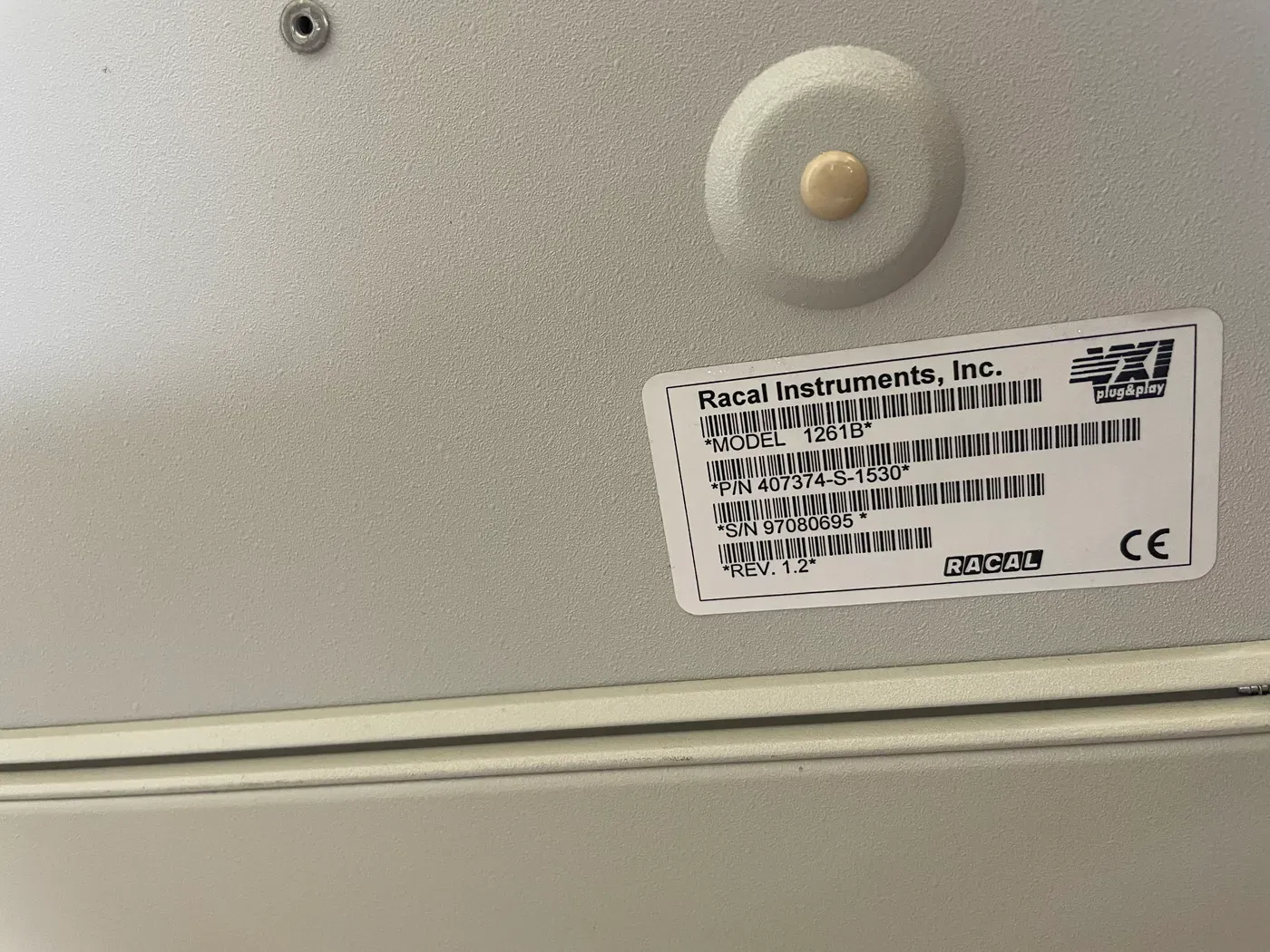
- Confirm the monitor type first. Basic, SMS or EMS changes both price and capability, and sellers don't always label it correctly. If you need software control and self-reporting, verify it's genuinely an EMS.
- Confirm 7U versus 9U and that you're getting the right one for bench or rack. Check the cable tray and any rack ears you need are included, because those options add up.
- Power it up and watch the rails and temperatures if it's SMS or EMS. Listen to all three fans and confirm none is dragging. Check the filters, and check the airflow blockers are actually there.
- For switch systems, confirm the smart cards are included and are the option you need. A pile of 1260 switch cards with no Option 01T is a pile you can't command until you source one.
- Ask about calibration and repair history and whether it comes with a certificate. A frame that's been maintained is worth more than a bargain that's been sitting in a closet with an unknown fault.
You'll find 1261B frames in defense and aerospace ATE, communications and radar test, satellite and satcom systems, and general high-reliability manufacturing test. Anywhere a system has to run for years, survive real environments, and route a lot of signals cleanly, this is the kind of frame that ends up doing it. The heavy cooling and the field-replaceable everything are what those users are paying for.
Common questions
How many slots does the Racal 1261B have?
Thirteen, numbered 0 through 12, all C-size VXIbus. Slot 0 goes to the resource manager, leaving twelve for instruments and switch cards.
What's the difference between the 7U and 9U versions?
The 7U is benchtop, drawing air in the rear and exhausting out the top. The 9U is rackmount, drawing from the sides and exhausting out the rear, with a built-in cable tray. Pick the 9U for a rack, the 7U for a bench.
Does the 1261B include a slot-0 controller?
No. It's the mainframe only. You add a slot-0 resource manager separately to connect it to your host PC. The EMS monitor does not do this job.
How much power does it deliver?
Up to 925 W to the slots from 0 to 40 C, and 1025 W from 0 to 30 C, at 230 VAC. The +5 V rail alone supplies up to 80 A peak.
Do I need a special power setup?
No. The input auto-ranges from 90 to 250 VAC and across frequency, so there's no voltage selector and it runs on standard mains or 400 Hz power without reconfiguration.
SMS or EMS, which do I need?
SMS gives you LED status monitoring and analog outputs at no slot cost. EMS adds programmable limits, VXIbus and RS-232 readout, interrupts, and trigger routing, and speaks SCPI. Buy EMS if you want the chassis controllable and self-reporting in software.
Can I run modules from other manufacturers?
Yes. Any C-size, VXIbus-compliant module works. It's an open standard, not a Racal-only chassis.
Do I need an Option 01 or 01T for the 1260 switch cards?
Yes. The switch cards are register-based and need a smart controller in the leftmost slot of the switch group. Use the 01T with SCPI for anything new. Option 01 is for legacy systems only, and the two are not interchangeable in software.
How many switch cards can one Option 01T control?
Up to twelve modules or Adapt-a-Switch plug-ins from a single point of control.
What happens if a cooling fan fails?
The system keeps running. The three-fan design is fault-tolerant, so two fans keep cooling at a high level. Replace the failed assembly promptly to restore redundancy.
Why is my chassis overheating even though it looks fine?
Almost always missing airflow blockers in empty slots, or a clogged filter. The pressurized cooling depends on every empty slot being sealed.
Is the 1261B still worth running?
For fielded and legacy ATE, absolutely. The fault-tolerant cooling and the sub-five-minute field-replaceable parts keep it reliable, and units are still fully repairable and calibratable.
What we do with these
We keep 1261B mainframes and 1260-series modules moving through our bench, tested and calibrated and verified to spec before they ship. If you're hunting a specific configuration, need a chassis or switch cards repaired, or you've got surplus VXI gear sitting idle, that's our lane. We handle the whole path, from a single module to a fully populated frame.
Calibration is in-house and NIST-traceable, with measured data on the certificate rather than a pass sticker. And if you're staring at a fan alarm or a resource manager that sees nothing, send us the symptom before you ship anything. Plenty of the time it's a blocker, a filter, or a reseat, and we'll tell you that honestly.
Looking for a 1261B in a specific monitor configuration, or trying to work out whether that fault is the frame or a module? Send us the model and what you're seeing. We'll tell you what we think before you spend anything.