Anritsu MS2036C – VNA Master, Handheld Network Analyzer, 5 kHz to 6 GHz, with Spectrum Analysis to 9 GHz
Anritsu Network Analyzers. Bandwidth: 10 Hz to 100 kHz, Dynamic range: 100 dB.
- Model
- Anritsu MS2036C
- Calibration
- Available on request
- Price · starting from
- $11,500
- Status
- In stock
- RFQ ref
- MS2036C
This unit
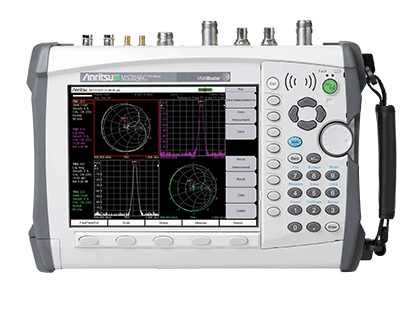
The Anritsu MS2036C VNA Master is a portable handheld instrument combining vector network analysis with spectrum analysis, designed for field deployment across RF and wireless environments. Operating from 5 kHz to 6 GHz as a VNA and 9 kHz to 9 GHz in spectrum mode, it delivers true 2-port, fully reversing architecture with 12-term error correction and dynamic range to 100 dB. The instrument executes measurements at 350 µs per point with up to 4,001 arbitrary data points, supports all standard calibration methods, and includes optional time-domain analysis with gating and TDR-type display capability. Its integrated spectrum analyzer features 1 Hz to 10 MHz resolution bandwidth, 30 MHz capture bandwidth, and noise floor to -161 dBm, with burst detection for intermittent signals as short as 200 µS and automated measurements including occupied bandwidth and adjacent channel power. The 21.3 cm display renders user-defined quad views of all four S-parameters simultaneously. Field-rated construction meets MIL-PRF-28800F Class 2, measures 211 mm × 315 mm × 97 mm, and weighs 4.8 kg with 3-hour battery autonomy. Dual USB and Ethernet interfaces enable remote control and data transfer. Waveguide and coaxial connectors are supported across all measurement modes.
Technical Specifications Vector Network Analyzer
Frequency: 5 kHz to 6 GHz
2-port, fully reversing architecture
S-parameter measurement: S11, S21, S22, S12
12-term error correction; SOLR, SSLR, SSSR calibration
Measurement speed: 350 µs per point; up to 4,001 data points
IF bandwidth: 10 Hz to 100 kHz
Dynamic range: 100 dB
Directivity: >42 dB to 6 GHz Spectrum Analyzer
Frequency: 9 kHz to 9 GHz
RBW: 1 Hz to 10 MHz; capture bandwidth 30 MHz
Amplitude range: +30 dBm; noise floor -161 dBm
Burst detection: 200 µS minimum signal capture
Automated measurements: occupied bandwidth, adjacent channel power, emission mask
Built-in AM/FM/SSB demodulator Electrical
Source power: +3 dBm or -25 dBm
Maximum output: 0 dBm Physical & Power
Dimensions: 211 mm × 315 mm × 97 mm
Weight: 4.8 kg
Display: 21.3 cm (800 × 600)
Operating temperature: -10°C to +55°C
Battery life: 3 hours
Compliance: MIL-PRF-28800F Class 2
Key Features
Real-time sweep updates exceed 350 µsec per point
Quad display for simultaneous S-parameter viewing
Fast sweep speeds for interference hunting
PIM hunting mode (with MW82119B)
Coverage mapping capability
Optional interference analysis
Time-domain gating and low-pass step response
Typical Applications
Field network characterization and validation
Interference identification and mitigation
Impedance and transmission-line measurement
PIM detection in wireless infrastructure
Device and component S-parameter validation
Compatibility & Integration
USB and Ethernet interfaces
Coaxial and waveguide connector support
Waveguide measurements across all models
Specifications
| Parameter | Value |
|---|---|
| Frequency Range | 5 kHz to 6 GHz (VNA) |
| 9 kHz to 9 GHz (Spectrum Analyzer) | Power Range (dBm) | '-161 dBm to +30 dBm |
Anritsu MS2036C — Repair & Calibration Service
Aumictech offers NIST-traceable calibration and repair for the Anritsu MS2036C. All calibrations are performed to NIST-traceable standards and ship with a certificate. Turnaround is typically 1–3 business days after receipt.
Anritsu MS2036C price
This Anritsu MS2036C is listed at $11,500. Calibration is available separately from $450. Contact us for volume pricing or if you need multiple units.
Anritsu MS2036C calibration cost
NIST-traceable calibration for the Anritsu MS2036C is $450 (standard — pass/fail certificate and calibration sticker) or $650 (full measured data at every test point, reference standards documented, traceability chain included). Turnaround is 1 to 3 business days after receipt. See full calibration details →