Stanford Research FS730 – Seven-channel Distribution Amplifier
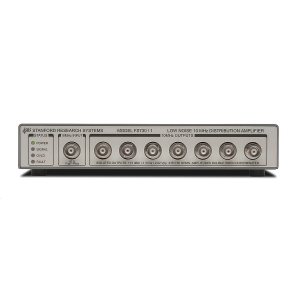
The Stanford Research FS730 is a seven-channel distribution amplifier designed for distributing signals from a single source to multiple destinations. It offers high isolation and low noise, ensuring signal integrity in demanding applications.
- Model
- Stanford Research FS730
- Calibration
- Available on request
- Price · starting from
- $1,890
- Status
- In stock
- RFQ ref
- FS730
This unit
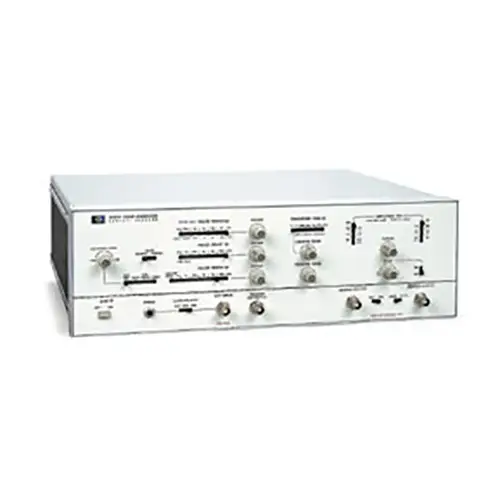
The Stanford Research FS730 is a seven-channel distribution amplifier that replicates and synchronizes signals from a single source to multiple destinations with exceptional timing precision. Housed in a compact half-width benchtop chassis, it delivers low-jitter signal distribution across DC to 50 MHz with configurable frequency options. The unit accommodates virtually any waveform with near-50% duty cycle and CMOS-level logic pulses, making it ideal for multi-channel synchronization in test and measurement systems.
Technical Specifications
Inputs & Signal Conditioning- Single AC-coupled or DC-coupled input with 1 kΩ impedance
- Input frequency range: DC to 50 MHz
- Schmitt trigger input with 1.3 VDC switching threshold (L-H) and 0.35 V hysteresis
- Input limiter conditions signals by removing amplitude modulation and blocking noise beyond 50 mV from zero-crossing
- Minimum pulse width: >5 ns
- Input overload indication at ±2 V; signal presence LED flashes at >300 mV Outputs
- Seven independent output channels
- 50 Ω ± 5% source impedance (optional 75 Ω available)
- Output levels: 0 VDC and 5.0 VDC (high-Z load); 0 VDC and 2.5 VDC (50 Ω load)
- 1 Vrms (+13 dBm) sine wave into 50 Ω load
- Output jitter: <10 ps rms
- Typical output delay: 9 ns with ±1 ns skew between channels
- Rise time: <1.5 ns; fall time: <1.0 ns
- Overshoot and undershoot: <5% each
- Configurable polarity via internal jumper (non-inverting as shipped)
- High channel-to-channel isolation at 10 MHz and beyond Physical & Power
- Benchtop chassis: half-width, 1U height
- Rack mountable with optional O730RMD kit (side-by-side mounting of two units in 19" rack)
- Power: 100/120/220/240 VAC, 50/60 Hz, 10 W (operates 90–132 VAC or 175–264 VAC, 47–63 Hz)
Key Features
- Sub-10 ps jitter preserves signal integrity across all seven channels
- Integrated input limiter eliminates amplitude variations and noise conditioning
- Fast rise/fall times (<1.5 ns / <1.0 ns) support high-speed digital and analog applications
- Flexible coupling options (AC/DC) accommodate diverse source impedances and DC offsets
Frequency Options
- FS730/1: One 10 MHz input, seven 10 MHz outputs
- FS730/2: One 5 MHz input, seven outputs
Typical Applications
- Multi-channel clock distribution in precision timing systems
- Signal synchronization across test instrumentation racks
- Reference distribution in RF and digital measurement setups
Specifications
| Parameter | Value |
|---|---|
| Frequency Range | DC to 50 MHz | Power Range (dBm): '+13 dBm (1 Vrms into 50 Ω) | Voltage / Current Range: 100/120/220/240 VAC, 50/60 Hz |
Stanford Research FS730 — Repair & Calibration Service
Aumictech offers NIST-traceable calibration and repair for the Stanford Research FS730. All calibrations are performed to NIST-traceable standards and ship with a certificate. Turnaround is typically 1–3 business days after receipt.
Stanford Research FS730 price
This Stanford Research FS730 is listed at $1,890. Calibration is available separately from $450. Contact us for volume pricing or if you need multiple units.
Stanford Research FS730 calibration cost
NIST-traceable calibration for the Stanford Research FS730 is $450 (standard — pass/fail certificate and calibration sticker) or $650 (full measured data at every test point, reference standards documented, traceability chain included). Turnaround is 1 to 3 business days after receipt. See full calibration details →