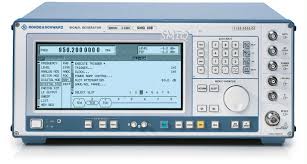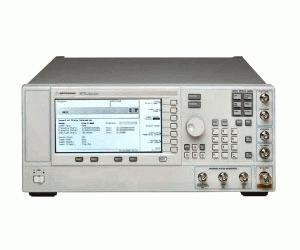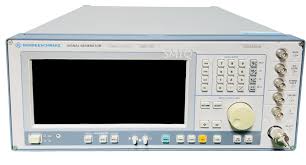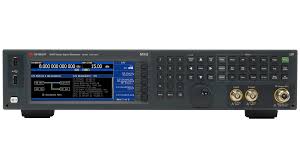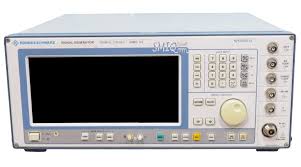
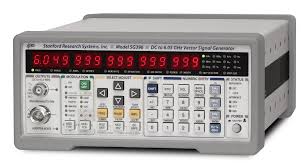
Stanford Research SG396 6 GHz Vector Generator
Stanford Research Vector Signal Generators. Frequency range: DC to 6.075 GHz, Resolution: 1 μHz, Bandwidth: 300 MHz.
- Model
- Stanford Research SG396
- Calibration
- Available on request
- Price · starting from
- $3,479
- Status
- In stock
- RFQ ref
- SG396
This unit
The Stanford Research Systems SG396 is a 6 GHz vector signal generator engineered for RF and microwave development requiring analog and vector modulation in a single platform. It combines Rational Approximation Frequency Synthesis (RAFS) with dual arbitrary waveform generators to deliver spur-free outputs, 1 μHz frequency resolution, and -116 dBc/Hz phase noise at 1 GHz. The instrument supports ASK, FSK, MSK, PSK, QAM, and VSB modulation with factory presets for GSM, EDGE, W-CDMA, APCO-25, DECT, NADC, PDC, ATSC-DTV, and TETRA standards.
Frequency switching occurs in under 8 ms to within 1 ppm. Dual baseband generators operate at 125 MHz with symbol rates to 6 MHz, while 300 MHz modulation bandwidth accommodates advanced I/Q applications. Digitally controlled attenuation spans 156 steps to -130 dB, with up to +25 dB gain and calibrated power control via a 40,000-element memory matrix.
Standard and optional rubidium timebases support frequency stability of 1 × 10⁻¹¹ (1 s Allan variance). RF output via Type N connector (above 950 kHz) and BNC for DC to 62.5 MHz signals. Direct AWGN injection capability supports noise-injection testing workflows.
Technical Specifications
- Frequency range: DC to 6.075 GHz
- Frequency resolution: 1 μHz
- Frequency synthesis: Rational Approximation Frequency Synthesis (RAFS)
- Frequency switching time: 40 dBc (>35 dBc above 4 GHz)
- Modulation bandwidth: 300 MHz
- I/Q inputs: 50 Ω, ±0.5 V
- Dual arbitrary waveform generators: 125 MHz operation, up to 6 MHz symbol rate
- AM modulation: 0 to 100% (0.1% resolution)
- AM distortion: <1% (fC < 62.5 MHz, fM = 1 kHz); 62.5 MHz, fM = 1 kHz)
- FM frequency deviation: 0.1 Hz minimum; frequency-dependent maximum
Key Features
- Spur-free synthesis via RAFS topology
- Vector modulation: ASK, FSK, MSK, PSK, QAM, VSB, and custom I/Q
- PSK derivatives: BPSK, QPSK, OQPSK, DQPSK, π/4DQPSK, 8PSK, 16PSK, 3π/8 8PSK
- QAM variants: 4, 16, 32, and higher orders
- VSB variants: 8VSB, 16VSB
- Standard modulation presets: GSM, EDGE, W-CDMA, APCO-25, DECT, NADC, PDC, ATSC-DTV, TETRA
- Direct AWGN injection into signal path
- Calibrated power control with 40,000-element memory matrix
- Ovenized or optional rubidium timebase
Typical Applications
- Wireless communications development and testing
- Radar system characterization
- Satellite communications signal generation
- Modulation validation across multiple standards
- Noise injection and receiver stress testing
Compatibility & Integration
- RF output: Type N connector (≥950 kHz)
- Baseband output: BNC (DC to 62.5 MHz)
- External modulation: ±0.5 V I/Q inputs at 50 Ω impedance
Specifications
| Parameter | Value |
|---|---|
| Frequency Range | DC to 6.075 GHz | Voltage / Current Range: ±0.5 V (I/Q inputs, 50 Ω) |
Stanford Research SG396 — Repair & Calibration Service
Aumictech offers NIST-traceable calibration and repair for the Stanford Research SG396. All calibrations are performed to NIST-traceable standards and ship with a certificate. Turnaround is typically 1–3 business days after receipt.
Stanford Research SG396 price
This Stanford Research SG396 is listed at $3,479. Calibration is available separately from $450. Contact us for volume pricing or if you need multiple units.
Stanford Research SG396 calibration cost
NIST-traceable calibration for the Stanford Research SG396 is $450 (standard — pass/fail certificate and calibration sticker) or $650 (full measured data at every test point, reference standards documented, traceability chain included). Turnaround is 1 to 3 business days after receipt. See full calibration details →