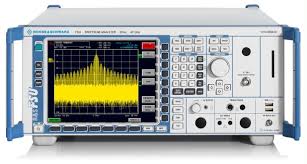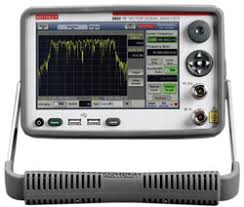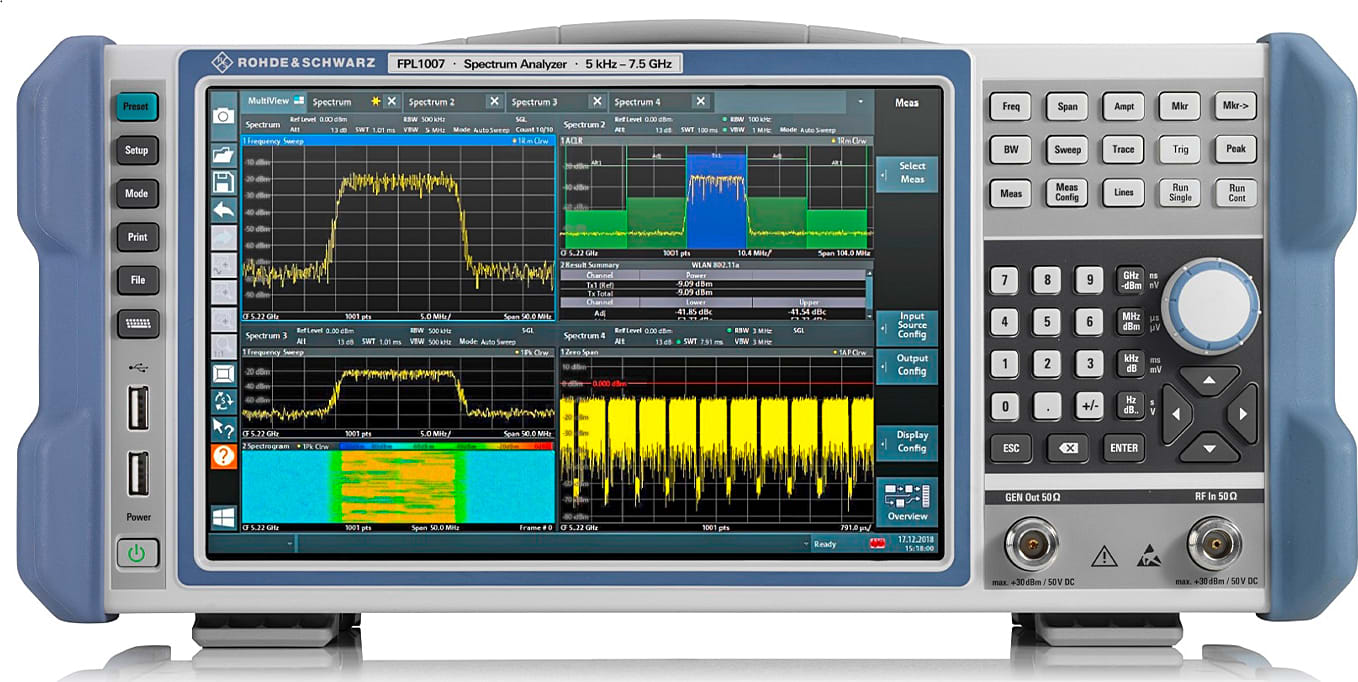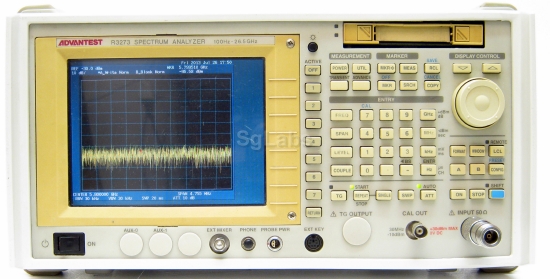
Advantest U3661 9KHz to 26.5GHz Spectrum Analyzer
Advantest Spectrum Analyzers. Frequency range: 9 kHz to 26.5 GHz, Bandwidth: 1 kHz to 3 MHz standard, Dynamic range: 100 dB.
- Model
- Advantest U3661
- Calibration
- Available on request
- Price
- $9,579
- RFQ ref
- U3661
This unit
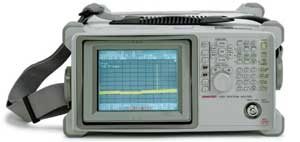
The Advantest U3661 is a portable microwave spectrum analyzer spanning 9 kHz to 26.5 GHz, engineered for field maintenance and signal analysis in microwave communications and TV broadcast relay applications. Its compact form factor - 148 mm × 291 mm × 330 mm, weighing 8 kg - combined with battery operation (up to 1.5 hours) and dual AC/DC power inputs, delivers measurement capability where facility power is unavailable.
Technical Specifications
Frequency & Resolution- Frequency range: 9 kHz to 26.5 GHz
- Resolution bandwidth: 1 kHz to 3 MHz standard; optional 100 Hz and 300 Hz narrow IF filters; 5 MHz in Zero Span mode with option 26
- Sweep time: 50 µs fast sweep; 50 µs high-speed sweep in Zero Span mode Signal Measurement
- Displayed average noise level (DANL): –132 dBm with preamplifier
- Phase noise (SSB): –105 dBc/Hz to 3 GHz; –100 dBc/Hz at 10 kHz offset
- Dynamic range: 100 dB
- Total level error: 1 dB
- Amplitude range: +30 dBm to average display noise level
- Maximum input level: +27 dBm
- Integrated preamplifier gain: >25 dB (to 3 GHz) Demodulation & Analysis
- AM and FM demodulators
- Frequency counter: 1 Hz resolution
- Markers: up to six per screen
- Measurement functions: adjacent channel power (ACP), occupied bandwidth (OBW), spurious emission, adjacent-channel leakage power, total power measurement for spread spectrum signals
- Optional CDMA measurement functions; optional TV signal receiver/demodulator capability
- Optional tracking generator: 2.2 GHz (2.7 GHz with option 74), output –31 to 0 dBm in 1 dB steps
- Optional SWR bridge Display & Storage
- 6-inch color TFT LCD display
- Two PCMCIA card drives for measurement results and settings Interfaces
RS-232, GPIB, 10 MHz frequency reference input, external trigger, gate input, external DC input, video output. Optional TV video/audio input and output (option 72). Power Supply
- AC: 100/200 VAC
- External DC: +10 to +16 VDC
- Battery: up to 1.5 hours (standard); 1 hour (specialized); 2-hour recharge cycle
Key Features
- Field-portable design with battery independence
- Low noise floor suitable for weak signal detection
- Rapid measurement sweep capability
- Integrated preamplification for enhanced sensitivity
- Modular options for specialized applications (CDMA, TV, tracking generation, SWR)
Typical Applications
- Microwave communications system commissioning and maintenance
- TV broadcast relay facility inspection
- Signal presence verification and interference identification
- Spurious emission compliance verification
- Spread spectrum signal analysis
Compatibility & Integration Standard laboratory interfaces (RS-232, GPIB) enable integration with automated test systems. External frequency reference and trigger inputs support synchronized multi-instrument setups. TV signal interfaces (optional) support broadcast transmission quality assessment.
Specifications
| Parameter | Value |
|---|---|
| Frequency Range | 9 kHz to 26.5 GHz | Power Range (dBm): '-132 dBm to +30 dBm | Voltage / Current Range: 100/200 VAC |
Advantest U3661 — Repair & Calibration Service
Aumictech offers NIST-traceable calibration and repair for the Advantest U3661. All calibrations are performed to NIST-traceable standards and ship with a certificate. Turnaround is typically 1–3 business days after receipt.
Advantest U3661 price
This Advantest U3661 is listed at $9,579. Calibration is available separately from $450. Contact us for volume pricing or if you need multiple units.
Advantest U3661 calibration cost
NIST-traceable calibration for the Advantest U3661 is $450 (standard — pass/fail certificate and calibration sticker) or $650 (full measured data at every test point, reference standards documented, traceability chain included). Turnaround is 1 to 3 business days after receipt. See full calibration details →