Anritsu MS2711D – Handheld Spectrum Analyzer; 100 kHz to 3 GHz
Anritsu Spectrum Analyzers. Frequency range: 100 kHz to 3.0 GHz (tunable to 9 kHz), Accuracy: ±2 ppm, Accuracy: ±1 dB typical (±1.5 dB max) from ≥10 MHz to 3.
- Model
- Anritsu MS2711D
- Calibration
- Available on request
- Price
- $2,400
- RFQ ref
- MS2711D
This unit
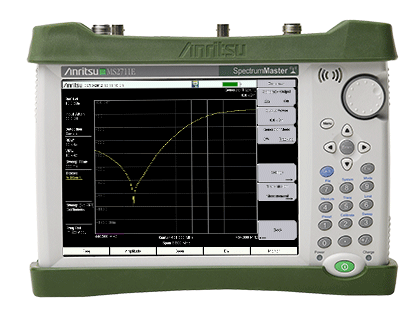
The Anritsu MS2711D is a portable handheld spectrum analyzer delivering signal analysis from 100 kHz to 3.0 GHz. Built for field deployment, it combines rugged construction with battery operation to support installation, maintenance, and interference troubleshooting across wireless communication systems. The instrument features a sunlight-readable TFT display, menu-driven interface, and one-button measurements for field strength, channel power, occupied bandwidth, and ACPR - enabling rapid diagnostics without operator expertise.
Its tunable frontend (down to 9 kHz) and switchable demodulation modes (AM, narrowband FM, wideband FM, USB/LSB) adapt to diverse RF environments. With frequency reference accuracy of ±2 ppm and aging of ±1 ppm/yr, the MS2711D delivers the precision needed for signal identification and source location in challenging field conditions.
Technical Specifications
Frequency Performance- Frequency range: 100 kHz to 3.0 GHz (tunable to 9 kHz)
- Frequency span: 10 Hz to 2.99 GHz with 1-2-5 step selections and zero span
- Frequency reference accuracy: ±2 ppm
- Frequency reference aging: ±1 ppm/yr Amplitude & Sensitivity
- Amplitude range: +20 to –135 dBm
- Total level accuracy: ±1 dB typical (±1.5 dB max) from ≥10 MHz to 3 GHz; ±2 dB typical below 10 MHz for input levels ≥–60 dBm
- Amplitude accuracy: ±0.5 dB typical
- Sensitivity: ≤–135 dBm (100 Hz RBW, full span)
- Noise level (preamp on): <–135 dBm
- Input attenuator range: 0 to 51 dB, 1 dB steps Resolution & Sweep
- Resolution bandwidth: 100 Hz to 1 MHz in 1-3 sequence
- RBW accuracy: ±5% typical
- Full span sweep time: ≤1.1 seconds
- Zero span sweep time: 50 µs to 200 seconds (selectable) Demodulation
- Built-in AM, narrowband FM, wideband FM, and single sideband (USB/LSB) demodulation
Key Features
- One-button measurements reduce test complexity for field personnel
- Sunlight-readable display ensures visibility in outdoor installations
- Battery-powered operation enables extended field campaigns
- Residual responses: 90 dBm (10 kHz RBW, preamp on)
Typical Applications
- Wireless system installation and commissioning
- RF interference detection and localization
- Channel power and adjacent channel measurement
- Occupied bandwidth assessment
Compatibility & Integration
- Transmission measurement option (Option 21): 25 MHz to 3 GHz / 25 MHz to 2.5 GHz
- Channel scanner (Option 27): 100 kHz to 3.0 GHz
- Power meter option (Option 29): 3 MHz to 3.0 GHz
- External power monitor (Option 5): up to 50 GHz
- Frequency converter module (FCN4760): 4.7 to 6.0 GHz
- High accuracy power meter (PSN50 sensor): 50 MHz to 6 GHz
Specifications
| Parameter | Value |
|---|---|
| Frequency Range | 100 kHz to 3.0 GHz | Power Range (dBm): '+20 to –135 dBm |
Anritsu MS2711D — Repair & Calibration Service
Aumictech offers NIST-traceable calibration and repair for the Anritsu MS2711D. All calibrations are performed to NIST-traceable standards and ship with a certificate. Turnaround is typically 1–3 business days after receipt.
Anritsu MS2711D price
This Anritsu MS2711D is listed at $2,400. Calibration is available separately from $450. Contact us for volume pricing or if you need multiple units.
Anritsu MS2711D calibration cost
NIST-traceable calibration for the Anritsu MS2711D is $450 (standard — pass/fail certificate and calibration sticker) or $650 (full measured data at every test point, reference standards documented, traceability chain included). Turnaround is 1 to 3 business days after receipt. See full calibration details →