Stanford Research NL100 Nitrogen Laser
The Stanford Research Systems NL100 is a low-noise voltage preamplifier designed for amplifying low-level signals in various scientific and engineering applications. It offers high gain, low input noise, and wide bandwidth, making it suitable for use with detectors, transducers, and other signal sources. The NL100 features selectable gain settings, input impedance, and filtering options to optimize performance for specific applications. It is a valuable tool for researchers and engineers working with sensitive signals.
- Model
- Stanford Research Systems NL100
- Calibration
- Available on request
- Price · starting from
- $1,450
- Status
- In stock
- RFQ ref
- NL100
This unit
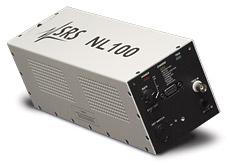
The Stanford Research Systems NL100 is a compact, pulsed nitrogen laser emitting at 337.1 nm for UV photochemistry, fluorescence spectroscopy, and MALDI-TOF mass spectrometry. This sealed, cartridge-based design eliminates mirror alignment while delivering 170 µJ pulses at up to 20 Hz with <3.5 ns pulse width and 45 kW peak power. Factory-aligned optics, TTL triggering, and integrated interlock control enable rapid experimental deployment with minimal setup overhead.
Technical Specifications
- Wavelength: 337.1 nm, spectral bandwidth 0.1 nm
- Pulse characteristics: <3.5 ns FWHM, 170 µJ energy, 45 kW peak power
- Repetition rate: 1–20 Hz (internal), 0–20 Hz (external TTL)
- Average power: 3 mW at 20 Hz maximum
- Beam profile: 3 mm × 7 mm, divergence 5 mrad × 8 mrad (full angle)
- Energy stability: 3% std. dev. (pulse-to-pulse at 10 Hz)
- Supply voltage: +24 VDC, 1.5 A average (20 Hz), 3 A peak
- Power consumption: 36 W at 20 Hz
- Dimensions: 9.5 cm × 9.5 cm × 27.9 cm (W × H × D); 3.4 kg
- Compliance: Class 3B, 21 CFR 1040.10
Key Features
- Replaceable sealed laser cartridge with integrated capacitor storage, switching element, and tube
- No mirror alignment required; optics permanently factory-mounted on plasma tube
- TTL-level external trigger input (opto-isolated) with optional sync output pulse
- Internal trigger generator with 1–20 Hz adjustment
- Built-in interlock switch and key switch for safety control
- Command Charge operating mode available
Typical Applications
- Fluorescence-based analytical techniques
- MALDI-TOF mass spectrometry ionization
- Photochemistry and photobiology research
- UV spectroscopy and time-resolved studies
Compatibility & Integration The NL100 is fully compatible with Spectra-Physics model VSL-337i OEM Nitrogen Laser (part #337999-04). Low-voltage +24 VDC supply requirement and TTL control interfaces simplify integration into OEM systems and custom benchtop setups.
Specifications
| Parameter | Value |
|---|---|
| Voltage / Current Range | '+24 Vdc, 1.5 A average (20 Hz), 3 A peak | Wavelength Range: 337.1 nm |
Stanford Research Systems NL100 — Repair & Calibration Service
Aumictech offers NIST-traceable calibration and repair for the Stanford Research Systems NL100. Calibration covers output power at specified wavelengths, wavelength accuracy, 15-minute output stability, and modulation frequency accuracy where applicable. All calibrations ship with a NIST-traceable certificate. Turnaround is typically 1–3 business days after receipt.
Common Stanford Research Systems NL100 faults: laser diode end-of-life (output below spec), fiber output connector damage, output instability. Common repairs include laser diode replacement when output falls below spec, fiber output connector repair, and thermal management service.
Stanford Research Systems NL100 price
This Stanford Research Systems NL100 is listed at $1,450. Calibration is available separately from $450. Contact us for volume pricing or if you need multiple units.
Stanford Research Systems NL100 calibration cost
NIST-traceable calibration for the Stanford Research Systems NL100 is $450 (standard — pass/fail certificate and calibration sticker) or $650 (full measured data at every test point, reference standards documented, traceability chain included). Calibration for this instrument covers output power at specified wavelengths, wavelength accuracy, 15-minute output stability, and modulation frequency accuracy where applicable. Turnaround is 1 to 3 business days after receipt. See full calibration details →