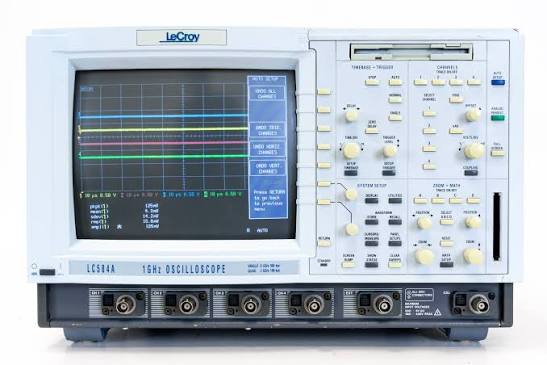
TEKTRONIX TDS520A 2-Chan 500MHz Digital Tek OSCILLOSCOPE
Tektronix Digital Oscilloscopes. Bandwidth: 500 MHz, Sample Rate: 500 MS/s per channel, Resolution: 8-bit native.
- Model
- Tektronix TDS520A
- Calibration
- Available on request
- Price
- $830
- RFQ ref
- TDS520A

This unit
The Tektronix TDS520A is a 2-channel, 500 MHz digital oscilloscope engineered for signal acquisition and analysis across research, development, and manufacturing environments. It delivers 500 MS/s sample rate per channel with 15 kpts record length and native 8-bit vertical resolution, expandable to 12-bit in Hi-Res Mode. The instrument supports multiple acquisition modes - including Peak Detect, Average (2 to 10,000 waveforms), FastFrame™ segmentation (up to 910 segments), and infinite persistence with 16-level gray scaling - enabling comprehensive signal characterization.
Advanced triggering includes Time Interval, 2-ns Glitch, Runt, State, and Pattern detection. The vertical front end accepts ±400 V (DC + peak AC) with selectable 1 mV to 10 V/div sensitivity and 1% accuracy. Input impedance options are 1 MΩ || 10 pF or 50 Ω, with channel isolation of ≥100:1 at 100 MHz and ≥30:1 at 500 MHz.
Twenty-five automatic measurements, waveform arithmetic (add, subtract, multiply, divide, invert), and optional FFT analysis (DC to 500 MHz, 500 to 10,000-point transform, 55–65 dB SNR) provide detailed signal insight. Autosetup enables single-button configuration. The 200 waveform/second update rate and cursor-based measurements support both routine diagnostics and complex fault isolation.
Technical Specifications
- Bandwidth: 500 MHz
- Channels: 2
- Sample Rate: 500 MS/s per channel
- Record Length: 15 kpts per channel
- Vertical Resolution: 8-bit native; 12-bit (Hi-Res Mode)
- Vertical Sensitivity: 1 mV to 10 V/div
- Vertical Accuracy: 1%
- Input Impedance: 1 MΩ || 10 pF or 50 Ω
- Maximum Input Voltage: ±400 V (DC + peak AC); derating 20 dB/decade above 1 MHz (1 MΩ or GND coupled)
- Channel Isolation: ≥100:1 @ 100 MHz; ≥30:1 @ 500 MHz
- AC Low Frequency Limit: ≤10 Hz (1 MΩ coupled); ≤200 kHz (50 Ω coupled)
- Input Coupling: AC, DC, GND
- Update Rate: 200 waveforms/second (500 points per waveform, infinite persistence)
Key Features
- Acquisition modes: Infinite/Variable Persistence, Average, Hi-Res, Peak Detect, FastFrame™ (910 segments, >50,000 triggers/second)
- Advanced triggering: Time Interval, 2-ns Glitch, Runt, State, Pattern
- 25 automatic measurements; cursor-based absolute and delta voltage, time, frequency analysis
- Waveform functions: Interpolation (sin x/x or linear), Average, Envelope
- Optional FFT: 500 to 10,000-point transform, DC to 500 MHz range, Rectangular/Hamming/Hanning/Blackman-Harris windowing, 55–65 dB SNR (Avg or HiRes mode)
- Optional functions: Integration, Differentiation
- Waveform limit testing and autosetup
- Gray scaling: 16 intensity levels for z-axis visualization
Typical Applications Signal debugging, power integrity analysis, high-speed digital characterization, analog circuit validation, educational instruction.
Compatibility & Integration Optional HDTV Video Triggering available for video signal analysis.
Specifications
| Parameter | Value |
|---|---|
| Frequency Range | DC to 500 MHz | Voltage / Current Range: ±400 V (DC + peak AC) |
Tektronix TDS520A — Repair & Calibration Service
Aumictech offers NIST-traceable calibration and repair for the Tektronix TDS520A. All calibrations are performed to NIST-traceable standards and ship with a certificate. Turnaround is typically 1–3 business days after receipt.
Tektronix TDS520A price
This Tektronix TDS520A is listed at $830. Calibration is available separately from $450. Contact us for volume pricing or if you need multiple units.
Tektronix TDS520A calibration cost
NIST-traceable calibration for the Tektronix TDS520A is $450 (standard — pass/fail certificate and calibration sticker) or $650 (full measured data at every test point, reference standards documented, traceability chain included). Turnaround is 1 to 3 business days after receipt. See full calibration details →