Anritsu MS9703C – Optical Spectrum Analyzer
Anritsu Optical Spectrum Analyzers. Accuracy: better than ±20 pm (post-calibration with optiona, Accuracy: ±0.1 dB to ±0.3 dB (1520–1620 nm.
- Model
- Anritsu MS9703C
- Calibration
- Available on request
- Price · starting from
- $2,900
- Status
- In stock
- RFQ ref
- MS9703C
This unit
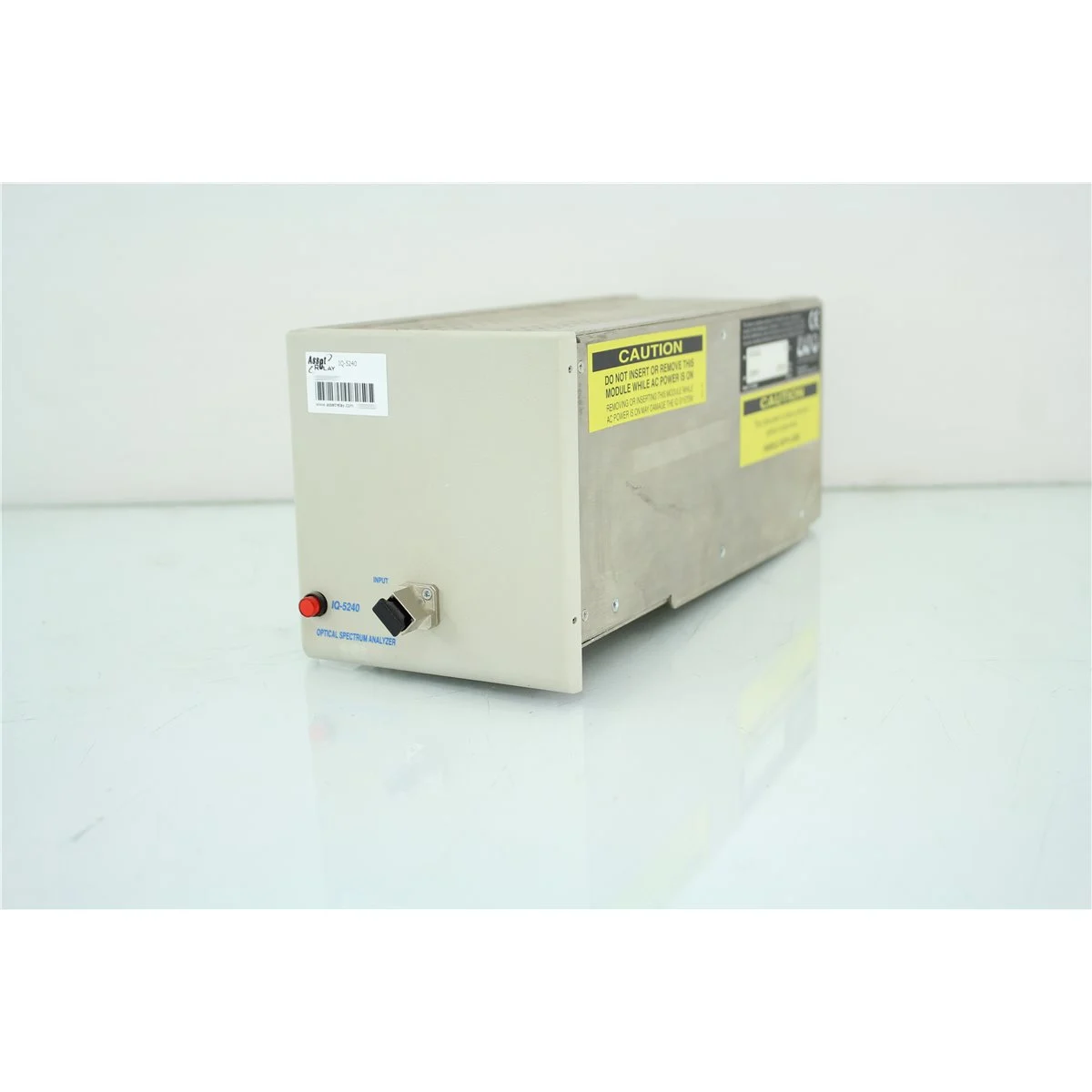
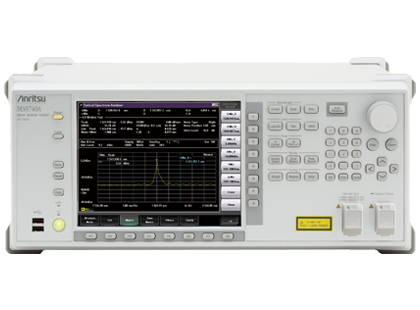
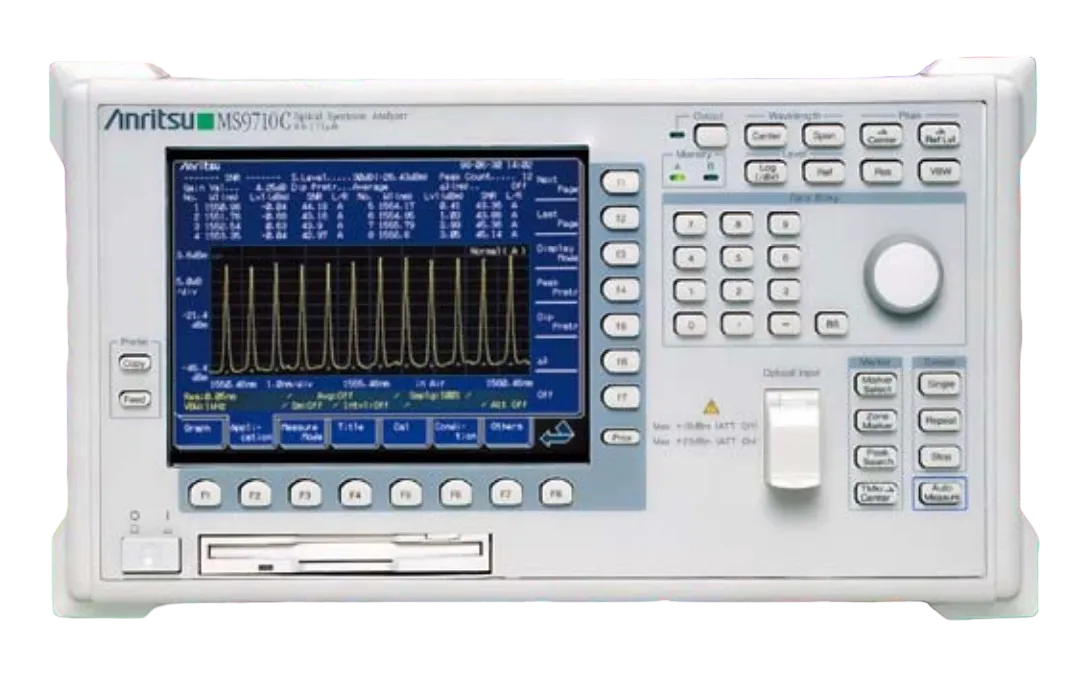
The Anritsu MS9703C is a optical spectrum analyzer engineered for precise characterization of optical devices and systems across the 600 nm to 1750 nm wavelength range. It delivers wavelength accuracy better than ±20 pm post-calibration, variable resolution bandwidth down to ≥0.07 nm, and input level measurement from –90 to +10 dBm depending on wavelength band. The instrument combines fast sweep speeds with dynamic range exceeding 42 dB at 0.2 nm in normal mode and 60 dB at 0.4 nm in high dynamic range mode, enabling detailed spectral analysis of DWDM systems with 50 GHz (0.4 nm) channel spacing. With a built-in optical attenuator for level control and SNR performance of ≥35 dB at 1300/1550 nm, the MS9703C supports quantitative measurement of signal quality across up to 300 DWDM channels.
Technical Specifications Wavelength Performance
Wavelength range: 600 nm to 1750 nm
Wavelength accuracy: better than ±20 pm (post-calibration with optional internal reference)
Resolution bandwidth (RBW): ≥0.07 nm, ≥0.1 nm, ≤0.1 nm; configurable settings at 0.2 nm, 0.5 nm, and 1 nm
Option 15 enhances accuracy, resolution, power flatness, and linearity in the 1570–1620 nm L-band region Level Measurement
Input range: –65 to +10 dBm (600–1000 nm); –85 to +10 dBm (1000–1250 nm); –90 to +10 dBm (1250–1600 nm)
Level accuracy: ±0.1 dB to ±0.3 dB (1520–1620 nm, 0.5 nm resolution); ±0.05 dB (–50 to +20 dBm, optical attenuator on/off)
Level stability: ±0.02 dB (1 min, RBW ≥0.1 nm, –23 dBm input)
Level flatness: ±0.05 dB (1550/1600 nm); ±0.1 dB (1300 nm) Dynamic Range & SNR
Normal mode: >42 dB at 0.2 nm; minimum 58 dB at 0.4 nm; 62 dB at 1 nm
High dynamic range mode: minimum 60 dB at 0.4 nm; minimum 70 dB at 1 nm
Signal-to-noise ratio: ≥35 dB (1300/1550 nm)
Key Features
Built-in optical attenuator for precise level control
Fast measurement speed
Supports PMD and EDFA noise floor measurements
Measures wavelength, power level, and SNR across up to 300 DWDM channels
Typical Applications
DWDM system characterization and verification
Optical device and component testing
Manufacturing and quality control
Research and development in optical communications
Specifications
| Parameter | Value |
|---|---|
| Power Range (dBm) | –90 to +10 dBm | Wavelength Range: 600 nm to 1750 nm |
Frequently Asked Questions
- What does the Anritsu MS9703C measure and what wavelength range does it cover?
- The MS9703C is an optical spectrum analyzer designed to measure optical power and wavelength characteristics across a 600 nm to 1750 nm range, making it suitable for both visible and infrared spectral analysis. It delivers power measurements from –90 to +10 dBm with accuracy of ±0.1 dB to ±0.3 dB in the critical 1520–1620 nm telecommunications window. This instrument is ideal for fiber-optic system characterization, DWDM channel monitoring, and broadband light source analysis.
- What condition is this MS9703C in, and what was verified before listing?
- This is a used unit that has been functionally tested and verified to power on and respond to basic commands before shipment. We perform visual inspection for physical damage and verify all connectors and display functionality; however, optical performance parameters should be validated through calibration or independent measurement if accuracy-critical applications are required. The instrument is sold as-is unless you select our optional calibration service.
- What does calibration cover for the MS9703C, and how much does it cost?
- Our calibration service for the MS9703C is available separately starting at $450 and includes wavelength accuracy verification and power measurement certification, bringing the instrument to post-calibration accuracy of better than ±20 pm. Calibration establishes traceability to NIST standards and is essential for metrology-grade measurements in telecommunications and research environments. Please contact our sales team for current turnaround times and any express service options.
- What interfaces and connectivity options does the MS9703C provide?
- The MS9703C supports GPIB (IEEE-488) and RS-232 interfaces for remote control and data transfer, enabling integration into automated test systems and laboratory networks. Compatible software drivers and command sets are available through Anritsu's documentation; we recommend verifying driver compatibility with your operating system and control platform before purchase. Contact us if you require specific connectivity details or legacy interface adapters.
Anritsu MS9703C — Repair & Calibration Service
Aumictech offers NIST-traceable calibration and repair for the Anritsu MS9703C. Calibration covers wavelength accuracy at 850, 1310, 1550, and 1625 nm, power level accuracy, resolution bandwidth (RBW) accuracy, and dynamic range verification. All calibrations ship with a NIST-traceable certificate. Turnaround is typically 1–3 business days after receipt.
Common Anritsu MS9703C faults: wavelength motor failure, internal light source dimming, detector sensitivity loss. Common repairs include wavelength motor servicing, internal broadband source replacement, and detector recalibration after extended use.
Anritsu MS9703C price
This Anritsu MS9703C is listed at $2,900. Calibration is available separately from $450. Contact us for volume pricing or if you need multiple units.
Anritsu MS9703C calibration cost
NIST-traceable calibration for the Anritsu MS9703C is $450 (standard — pass/fail certificate and calibration sticker) or $650 (full measured data at every test point, reference standards documented, traceability chain included). Calibration for this instrument covers wavelength accuracy at 850, 1310, 1550, and 1625 nm, power level accuracy, resolution bandwidth (RBW) accuracy, and dynamic range verification. Turnaround is 1 to 3 business days after receipt. See full calibration details →