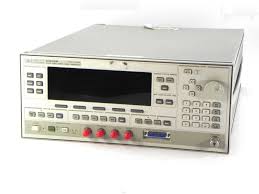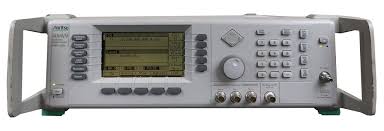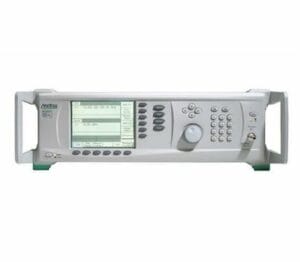
Stanford Research SG384 4 GHz Signal Generator
Stanford Research Systems Signal Generators. Frequency Range: DC to 4.05 GHz (standard), Resolution: 1 µHz, Resolution: 0.1%.
- Model
- Stanford Research Systems SG384
- Calibration
- Available on request
- Price · starting from
- $5,170
- Status
- In stock
- RFQ ref
- SG384
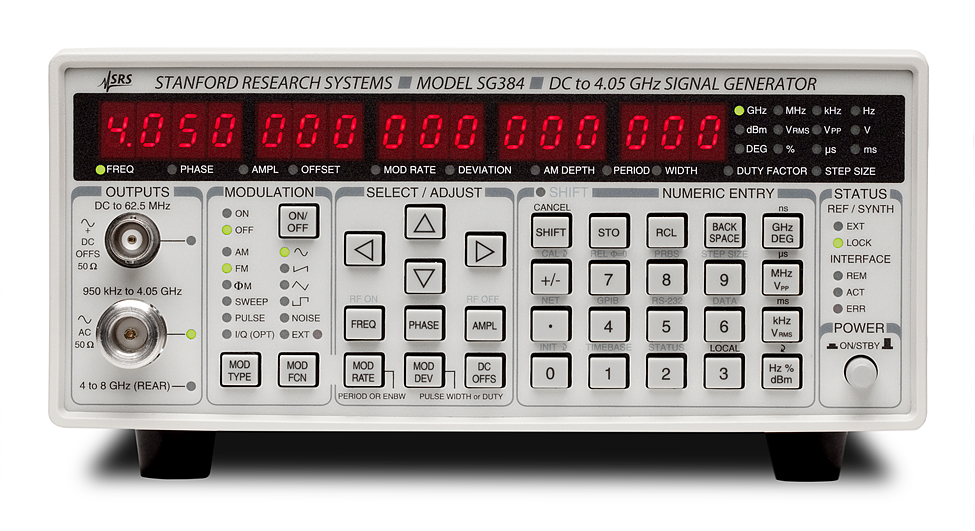
This unit
The Stanford Research Systems SG384 is a 4 GHz analog signal generator built on Rational Approximation Frequency Synthesis architecture. It delivers 1 µHz frequency resolution, sub-8 ms switching speed, and exceptional phase noise performance of -116 dBc/Hz at 20 kHz offset. The instrument supports AM, FM, phase modulation, pulse modulation, and continuous sweeps with selectable internal waveforms (sine, ramp, saw, square, pulse, noise) or external modulation sources.
RF output ranges from +13 dBm to -110 dBm with ±5% amplitude accuracy. Optional frequency doubler (Opt. 02) extends coverage to 8.10 GHz, while optional I/Q modulation (Opt. 03) enables complex signal generation above 400 MHz. A front-panel BNC output accommodates baseband and low-frequency signals to 62.5 MHz.
Suited for research, development, and production RF test environments.
Technical Specifications
- Frequency Range: DC to 4.05 GHz (standard); up to 8.10 GHz with optional doubler
- Frequency Resolution: 1 µHz
- Frequency Switching: <8 ms to within 1 ppm
- Frequency Stability: 1 × 10⁻¹¹ (1 second Allan variance)
- RF Output Power: +13 dBm to -110 dBm
- Amplitude Resolution: 0.1%
- Amplitude Accuracy: ±5%
- Phase Noise (SSB): -116 dBc/Hz at 20 kHz offset (1 GHz); -80 dBc/Hz at 10 Hz offset
- Harmonics: <-25 dBc at +7 dBm output
- Spurious: 40 dBc carrier suppression
- BNC front-panel output: DC to 62.5 MHz, 1 mV to 1 Vrms into 50 Ω
Typical Applications
- Component and subsystem RF testing
- Phase noise characterization
- Modulation development and validation
- Frequency-agile signal generation
Compatibility & Integration External modulation accepts ±1 V input signals. I/Q option supports 50 Ω impedance inputs with ±0.5 V offsets. Standard N-type RF connector.
Specifications
| Parameter | Value |
|---|---|
| Frequency Range | DC to 4.05 GHz (standard) |
| up to 8.10 GHz with optional doubler | Power Range (dBm) | '+13 dBm to -110 dBm | Voltage / Current Range: ±1 V (external modulation input) |
Stanford Research Systems SG384 — Repair & Calibration Service
Aumictech offers NIST-traceable calibration and repair for the Stanford Research Systems SG384. Calibration covers output frequency accuracy, output power level accuracy across the full frequency range, AM/FM/PM/pulse modulation accuracy, harmonic and spurious output levels, and phase noise floor verification. All calibrations ship with a NIST-traceable certificate. Turnaround is typically 1–3 business days after receipt.
Common Stanford Research Systems SG384 faults: YIG oscillator failure (no output or loss of lock), step attenuator wear (output drops or steps at set attenuation), ALC loop failure (uncontrolled output power), I/Q modulator assembly failure. HP/Agilent 836xx series most common faults are YIG oscillator failure and step attenuator contact wear causing output steps or drops at specific attenuation settings. Keysight E4428C/E4438C units most commonly develop ALC loop failure and I/Q modulator assembly faults. YIG oscillator replacement and attenuator service are stocked repairs.
Stanford Research Systems SG384 price
This Stanford Research Systems SG384 is listed at $5,170. Calibration is available separately from $450. Contact us for volume pricing or if you need multiple units.
Stanford Research Systems SG384 calibration cost
NIST-traceable calibration for the Stanford Research Systems SG384 is $450 (standard — pass/fail certificate and calibration sticker) or $650 (full measured data at every test point, reference standards documented, traceability chain included). Calibration for this instrument covers output frequency accuracy, output power level accuracy across the full frequency range, AM/FM/PM/pulse modulation accuracy, harmonic and spurious output levels, and phase noise floor verification. Turnaround is 1 to 3 business days after receipt. See full calibration details →