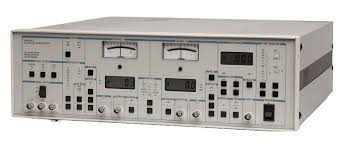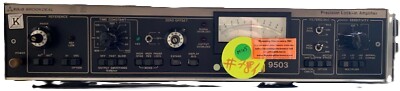
Stanford Research SR2124 Dual Phase Lock-in Amplifier
The Stanford Research SR2124 is a dual-phase lock-in amplifier designed for precision measurement of AC signals. It offers high sensitivity and excellent noise rejection, making it suitable for a wide range of scientific and engineering applications. Features include dual-phase operation, digital signal processing, and versatile interfacing options.
- Model
- Stanford Research Systems SR2124
- Calibration
- Available on request
- Price · starting from
- $10,930
- Status
- In stock
- RFQ ref
- SR2124
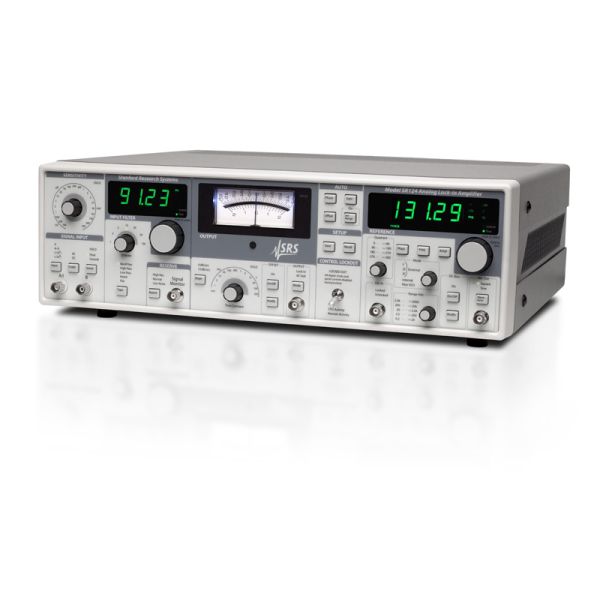
This unit
The Stanford Research SR2124 Dual Phase Lock-in Amplifier is a precision instrument for measuring small AC signals embedded in noise using all-analog design to eliminate digital interference. Operating across 0.2 Hz to 200 kHz, it achieves input sensitivity down to 100 nV full-scale with dynamic reserve to 80 dB - extendable to 100 dB with optional band-pass filtering. The instrument functions as either a lock-in amplifier or frequency-selective AC voltmeter, accepting both voltage and current inputs with selectable coupling modes.
Technical Specifications
- Frequency range: 0.2 Hz to 200 kHz
- Input sensitivity: 100 nV minimum full-scale
- Dynamic reserve: 80 dB (60 dB typical); up to 100 dB with optional input filtering
- Voltage input: Single-ended/differential FET preamplifier, 2.5 nV/√Hz noise floor, 10 MΩ input impedance
- Current input: Preamplifier with gains of 10⁶ V/A and 10⁸ V/A
- Reference output: Sine and square waveforms, amplitude 100 nV to 10 V
- Quadrant outputs: Four 1 Vrms sine waves at 0°, 90°, 180°, 270°
- Signal outputs: 1 µV to 20 Vpp into 10 kΩ load, 50 Ω output impedance
- Output time constants: 1 ms to 300 s, selectable –6 dB or –12 dB/octave rolloff
- Input filters: Flat, band-pass, high-pass, low-pass, notch with Q-factor 1–100
- AC/DC coupling: Both modes supported
- Grounding: Ground and Float modes
Key Features
- All-analog architecture eliminating digital noise sources
- Internal reference with ±0.1% accuracy
- External reference locking at f, 2f, or 3f with 100 mVpp minimum input
- Tunable narrow-band amplifier providing additional 60 dB rejection of out-of-band signals
- Two-stage output low-pass filtering with minimum time constant bypass
- Rear voltage-controlled oscillator (VCO) reference option
- Front and rear panel reference outputs
Typical Applications
- Low-temperature research requiring ultra-low noise performance
- Precision small-signal measurement in noisy environments
- Lock-in detection for phase-sensitive measurements
- AC signal characterization and frequency-selective analysis
Compatibility & Integration The SR2124 provides voltage and current input paths with independent coupling selection, front-panel reference output control, and multiple reference modes for flexible integration into measurement systems. Quadrant outputs enable external phase-shift applications.
Specifications
| Parameter | Value |
|---|---|
| Frequency Range | 0.2 Hz to 200 kHz | Voltage / Current Range: 100 nV to 10 V (reference output) |
Stanford Research Systems SR2124 — Repair & Calibration Service
Aumictech offers NIST-traceable calibration and repair for the Stanford Research Systems SR2124. Calibration covers full-scale sensitivity accuracy at 1 V and at each decade below the maximum range, time constant accuracy, phase offset and phase noise verification, reference frequency range and accuracy, dynamic reserve verification, and noise floor (V/√Hz) measurement. All calibrations ship with a NIST-traceable certificate. Turnaround is typically 1–3 business days after receipt.
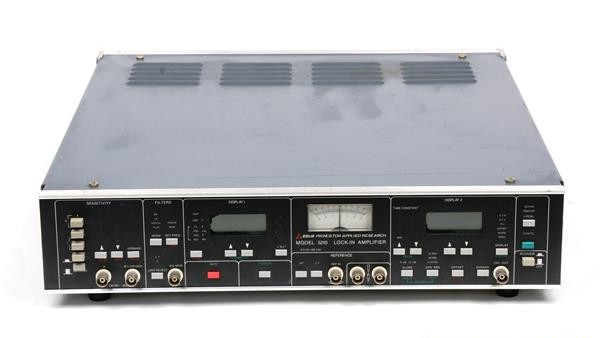
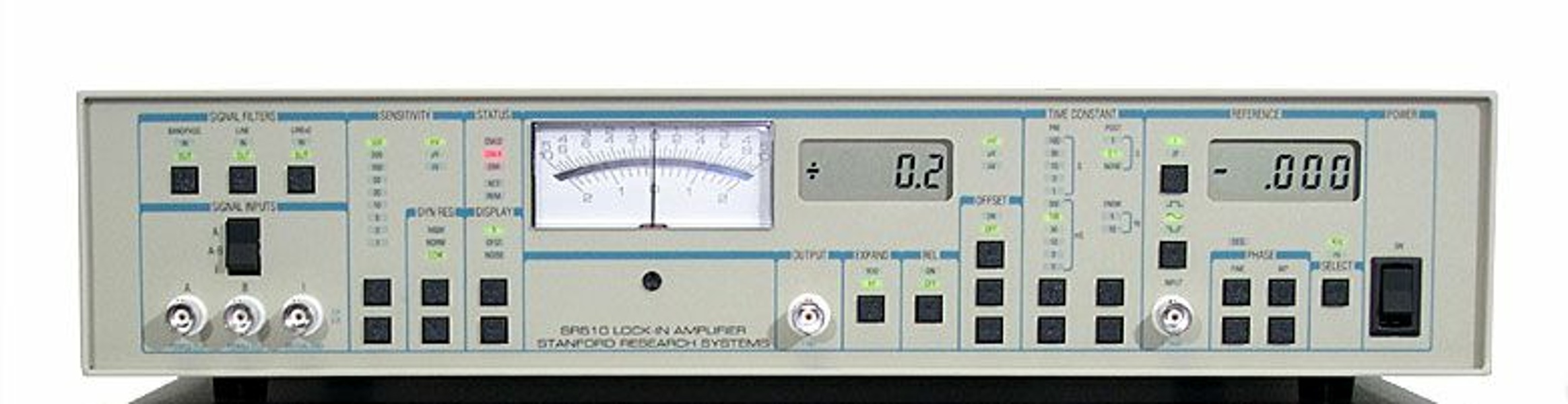
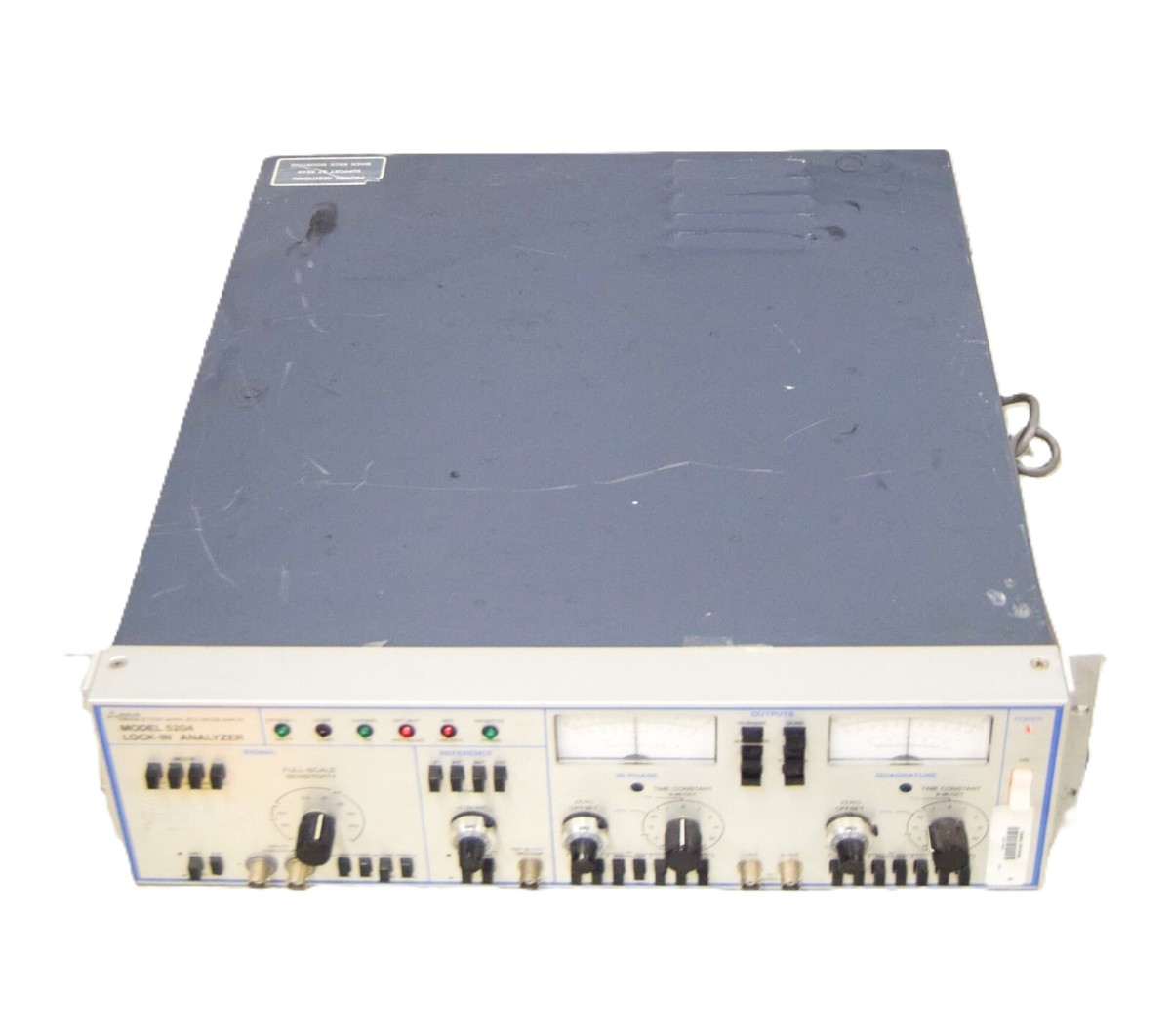
Common Stanford Research Systems SR2124 faults: keypad ribbon cable wear (intermittent key response), DSP board failure, reference input circuit failure, trim pot drift on analog models. Stanford Research SR810/830 most common fault is front-panel keypad ribbon cable wear causing intermittent key response. DSP board failure is rare but results in loss of lock and incorrect readings. EG&G 5204/5210 analog demodulator units most commonly develop trim pot drift requiring phase and offset recalibration.
Stanford Research Systems SR2124 price
This Stanford Research Systems SR2124 is listed at $10,930. Calibration is available separately from $450. Contact us for volume pricing or if you need multiple units.
Stanford Research Systems SR2124 calibration cost
NIST-traceable calibration for the Stanford Research Systems SR2124 is $450 (standard — pass/fail certificate and calibration sticker) or $650 (full measured data at every test point, reference standards documented, traceability chain included). Calibration for this instrument covers full-scale sensitivity accuracy at 1 V and at each decade below the maximum range, time constant accuracy, phase offset and phase noise verification, reference frequency range and accuracy, dynamic reserve verification, and noise floor (V/√Hz) measurement. Turnaround is 1 to 3 business days after receipt. See full calibration details →