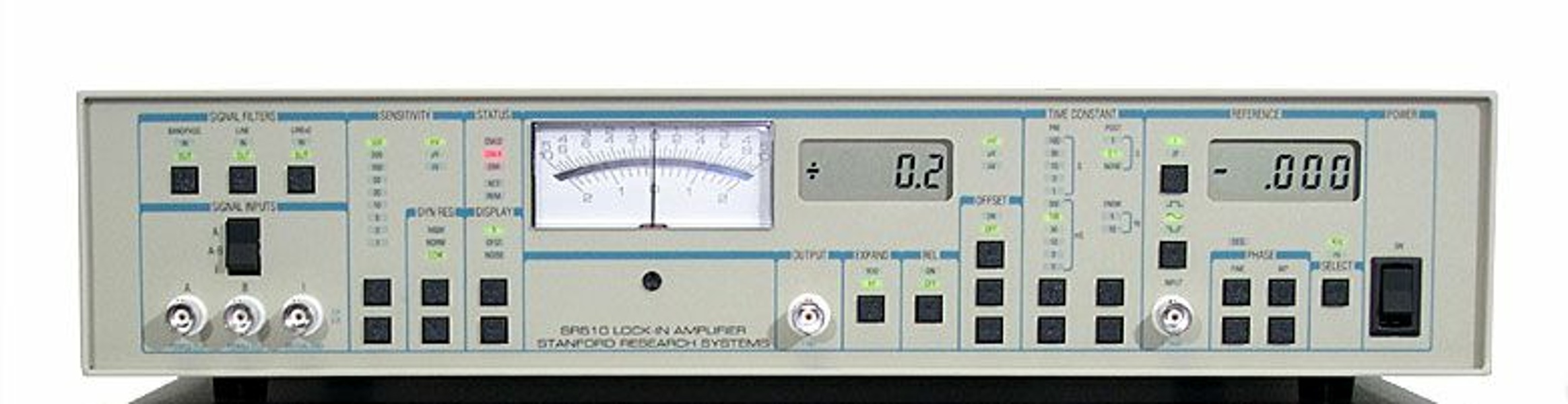
Stanford Research SR510 – Single Phase Lock-In Amplifier
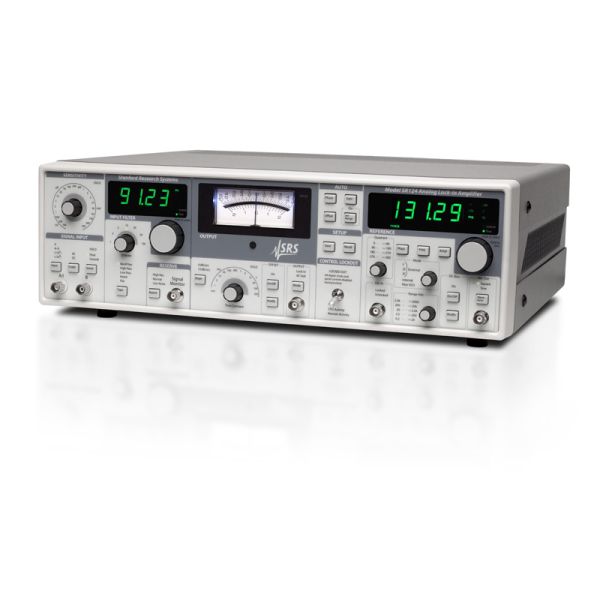
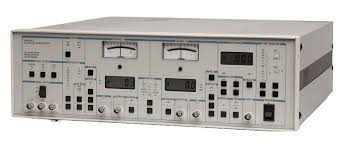
The Stanford Research Systems SR510 is a single-phase lock-in amplifier designed for recovering signals buried in noise. It features a frequency range of 0.5 Hz to 100 kHz, sensitivity down to 100 nV, and a dynamic reserve of 80 dB. Ideal for various scientific and engineering applications.
- Model
- Stanford Research Systems SR510
- Calibration
- Available on request
- Price · starting from
- $550
- Status
- In stock
- RFQ ref
- SR510
This unit
The Stanford Research Systems SR510 is a single-phase lock-in amplifier that detects and measures weak AC signals buried in significant noise through precision analog demodulation. Using a sine-wave multiplier, the instrument translates input signals down to DC, enabling subsequent filtering and amplification with exceptional sensitivity across a broad frequency range.
Technical Specifications
Signal Channel- Voltage input impedance: 100 MΩ + 25 pF (AC coupled)
- Current input impedance: 1 kΩ to virtual ground
- Current input gain: 10⁶ V/A
- Full-scale sensitivity (voltage): 100 nV to 500 mV
- Full-scale sensitivity (current): 100 fA to 0.5 µA
- Input noise (voltage): 7 nV/√Hz at 1 kHz
- Input noise (current): 0.13 pA/√Hz at 1 kHz
- Maximum input: 100 VDC, 10 VAC
- 60 Hz notch filter: 50 dB rejection, Q=10 (45–65 Hz adjustable)
- 120 Hz notch filter: 50 dB rejection, Q=10 (100–130 Hz adjustable)
- Tracking band-pass filter: Q=5, +20 dB dynamic reserve Reference Channel
- Frequency range: 0.5 Hz to 100 kHz
- Input impedance: 1 MΩ (AC coupled)
- Sine trigger: 100 mV minimum, 1 Vrms nominal
- Pulse trigger: ±1 V, 1 µs minimum width
- Detection modes: Fundamental (f) and 2nd harmonic (2f)
- Internal oscillator output: 0.01, 0.1, or 1 Vrms, up to 20 mA drive Demodulator & Output
- Pre-filter time constants: 1 ms to 100 s (6 dB/octave)
- Dynamic reserve: Up to 80 dB (with tracking band-pass filter)
- Frequency-voltage controlled oscillator: 1 Hz to 100 kHz
- Quadrant outputs: 0°, 90°, 180°, 270° phase shifts (1 Vrms sinewaves)
- Output meter: 2% precision analog, plus 4-digit LCD display
- Output BNC: ±10 V at full-scale input (<1 Ω impedance)
- Ratio output for servo applications
Key Features Precision analog sine-wave multipliers eliminate spurious harmonic responses. Dual notch filters suppress 60 Hz and 120 Hz interference. Selectable stability modes (5 ppm/°C to 500 ppm/°C) accommodate different operating conditions. Single-ended or differential voltage inputs with picoampere-level current sensitivity. Phase-locked detection at fundamental or second harmonic enables flexible measurement configurations.
Typical Applications Phase-sensitive detection of modulated signals. Characterization of low-impedance or high-impedance samples. Noise reduction in spectroscopy and materials analysis. Lock-in measurement of AC parameters in semiconductor and condensed-matter research.
Specifications
| Parameter | Value |
|---|---|
| Frequency Range | 0.5 Hz to 100 kHz | Voltage / Current Range: 10 VAC input, 100 nV to 500 mV (voltage) |
Stanford Research Systems SR510 — Repair & Calibration Service
Aumictech offers NIST-traceable calibration and repair for the Stanford Research Systems SR510. Calibration covers full-scale sensitivity accuracy at 1 V and at each decade below the maximum range, time constant accuracy, phase offset and phase noise verification, reference frequency range and accuracy, dynamic reserve verification, and noise floor (V/√Hz) measurement. All calibrations ship with a NIST-traceable certificate. Turnaround is typically 1–3 business days after receipt.
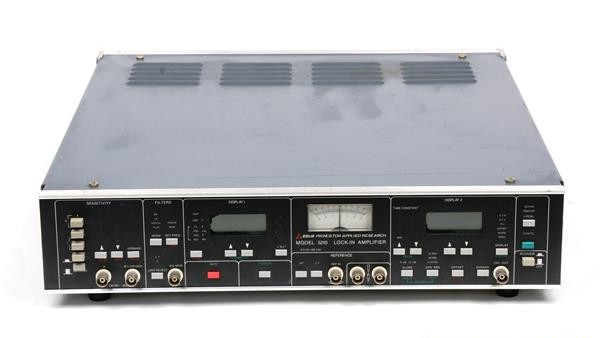
Common Stanford Research Systems SR510 faults: keypad ribbon cable wear (intermittent key response), DSP board failure, reference input circuit failure, trim pot drift on analog models. Stanford Research SR810/830 most common fault is front-panel keypad ribbon cable wear causing intermittent key response. DSP board failure is rare but results in loss of lock and incorrect readings. EG&G 5204/5210 analog demodulator units most commonly develop trim pot drift requiring phase and offset recalibration.
Stanford Research Systems SR510 price
This Stanford Research Systems SR510 is listed at $550. Calibration is available separately from $450. Contact us for volume pricing or if you need multiple units.
Stanford Research Systems SR510 calibration cost
NIST-traceable calibration for the Stanford Research Systems SR510 is $450 (standard — pass/fail certificate and calibration sticker) or $650 (full measured data at every test point, reference standards documented, traceability chain included). Calibration for this instrument covers full-scale sensitivity accuracy at 1 V and at each decade below the maximum range, time constant accuracy, phase offset and phase noise verification, reference frequency range and accuracy, dynamic reserve verification, and noise floor (V/√Hz) measurement. Turnaround is 1 to 3 business days after receipt. See full calibration details →