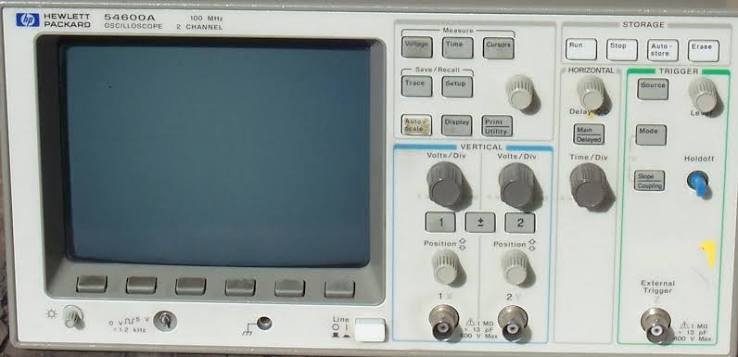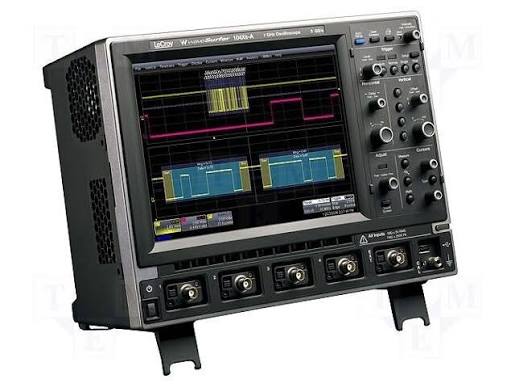
Instek GDS-806C 2-Channel Digital Storage Oscilloscope
Instek Digital Oscilloscopes. Sample rate: 100 MSa/s maximum per channel, Sample rate: 25 GSa/s maximum per channel, Bandwidth: 60 MHz.
- Model
- Instek GDS-806C
- Calibration
- Available on request
- Price
- $450
- RFQ ref
- GDS-806C
This unit
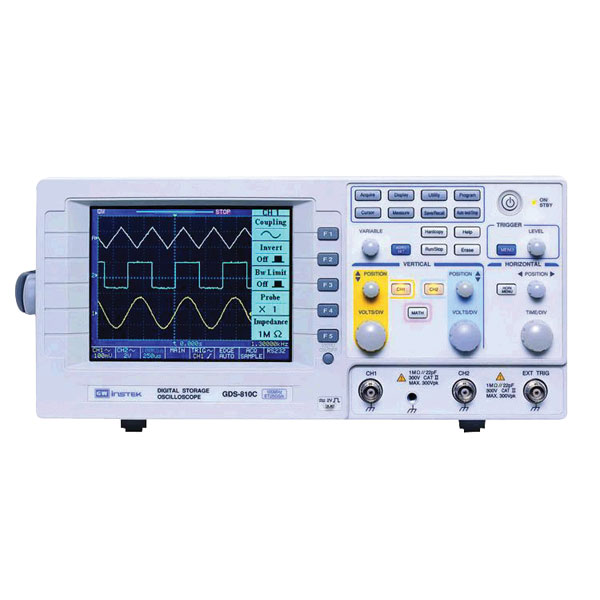
The Instek GDS-806C is a 2-channel digital storage oscilloscope delivering 60 MHz bandwidth with real-time acquisition at 100 MSa/s per channel and equivalent-time sampling to 25 GSa/s. Built around a 5.7-inch color LCD display, this instrument combines 125k points/channel memory depth with 8-bit vertical resolution and vertical sensitivity from 2 mV/div to 5 V/div, making it suitable for education, research, and industrial troubleshooting across a broad range of signal frequencies and amplitudes.
Technical Specifications Acquisition & Sampling
Real-time sample rate: 100 MSa/s maximum per channel
Equivalent-time sample rate: 25 GSa/s maximum per channel
Record length: 125k points per channel
Peak detection window: 10 ns (at 500 ns/div ~ 10 s/div)
Acquisition modes: Sample, Peak Detect, Average (2, 4, 8, 16, 32, 64, 128, 256) Vertical System
Bandwidth: 60 MHz
Vertical resolution: 8-bit
Sensitivity: 2 mV/div to 5 V/div
Vertical accuracy: ±3%
Input coupling: AC, DC, HF, LF, Noise Reject
Input impedance: 1 MΩ ±2%, ~18 pF
BW limit: 20 MHz (-3 dB)
Maximum input voltage: 300 V DC+AC peak (CATII)
Offset range: 2 mV/div to 50 mV/div Horizontal System
Time base range: 1 ns/div to 10 s/div (1-2-5 increments)
Roll mode: 250 ms/div to 10 s/div
Time base accuracy: 0.01%
Pre-trigger delay: 20 divisions maximum; post-trigger: 1000 divisions
Display modes: Main, Window, Window Zoom, Roll, X-Y Trigger Capabilities
Sources: CH1, CH2, Line, Ext
Modes: Auto Level, Auto, Normal, Single, TV, Edge, Pulse Width, Time Delay, Event Delay
Sensitivity (DC–25 MHz): approximately 0.5 div or 5 mV
Sensitivity (25–60 MHz): approximately 1.5 div or 15 mV Display & Measurement
Display: 5.7-inch color LCD
Graticule: 8 or 10 divisions (8 × 12 div with menu off)
Auto voltage measurements: V, Vpp, average, RMS, high, low, maximum, minimum
Auto time measurements: frequency, period, rise time, fall time, positive width, negative width, duty cycle
Cursor measurements: voltage difference (ΔV), time difference (ΔT), reciprocal frequency (1/ΔT)
X-Y mode phase shift: 3° at 100 kHz
Key Features
Dual-channel configuration with independent vertical control
Wide vertical sensitivity range accommodates signals from millivolt to 50-volt scales
Multiple acquisition modes with frame averaging up to 256
Pre- and post-trigger delay for precise event capture
FFT waveform processing for frequency-domain analysis
Comprehensive triggering suite including pulse width and time delay modes
Typical Applications
Digital and analog circuit verification in design and production
Signal characterization in educational laboratories
Power supply ripple and noise measurement
Clock and timing analysis
Frequency response testing
Compatibility & Integration Standard interfaces enable data transfer and external control integration. X-Y plotting capability supports phase relationship analysis between two channels.
Specifications
| Parameter | Value |
|---|---|
| Frequency Range | DC to 60 MHz | Voltage / Current Range: 2 mV/div to 5 V/div |
Instek GDS-806C — Repair & Calibration Service
Aumictech offers NIST-traceable calibration and repair for the Instek GDS-806C. All calibrations are performed to NIST-traceable standards and ship with a certificate. Turnaround is typically 1–3 business days after receipt.
Instek GDS-806C price
This Instek GDS-806C is listed at $450. Calibration is available separately from $450. Contact us for volume pricing or if you need multiple units.
Instek GDS-806C calibration cost
NIST-traceable calibration for the Instek GDS-806C is $450 (standard — pass/fail certificate and calibration sticker) or $650 (full measured data at every test point, reference standards documented, traceability chain included). Turnaround is 1 to 3 business days after receipt. See full calibration details →