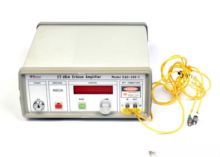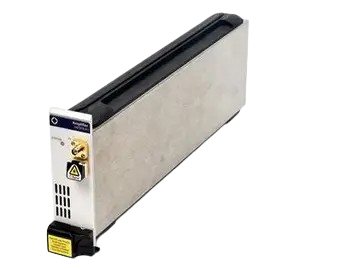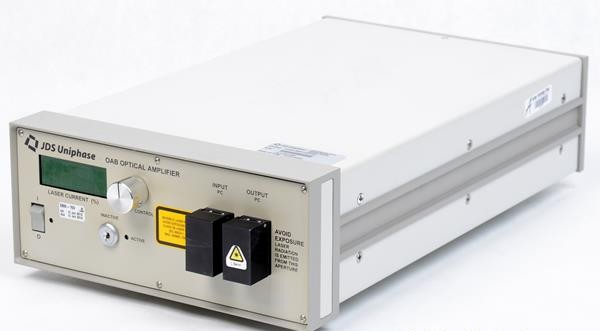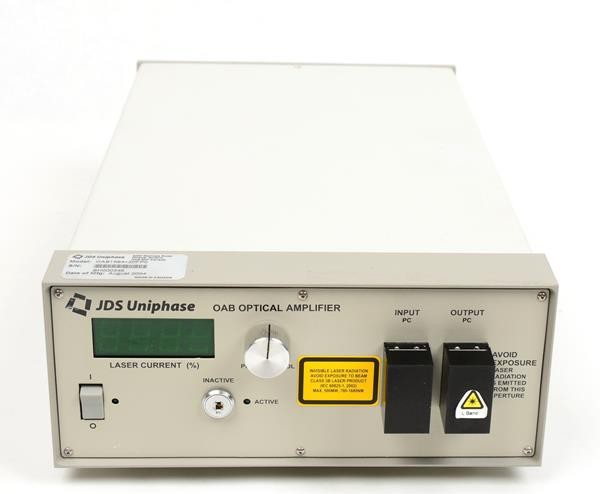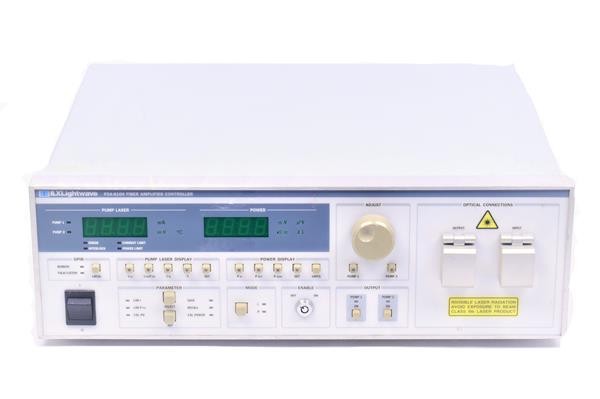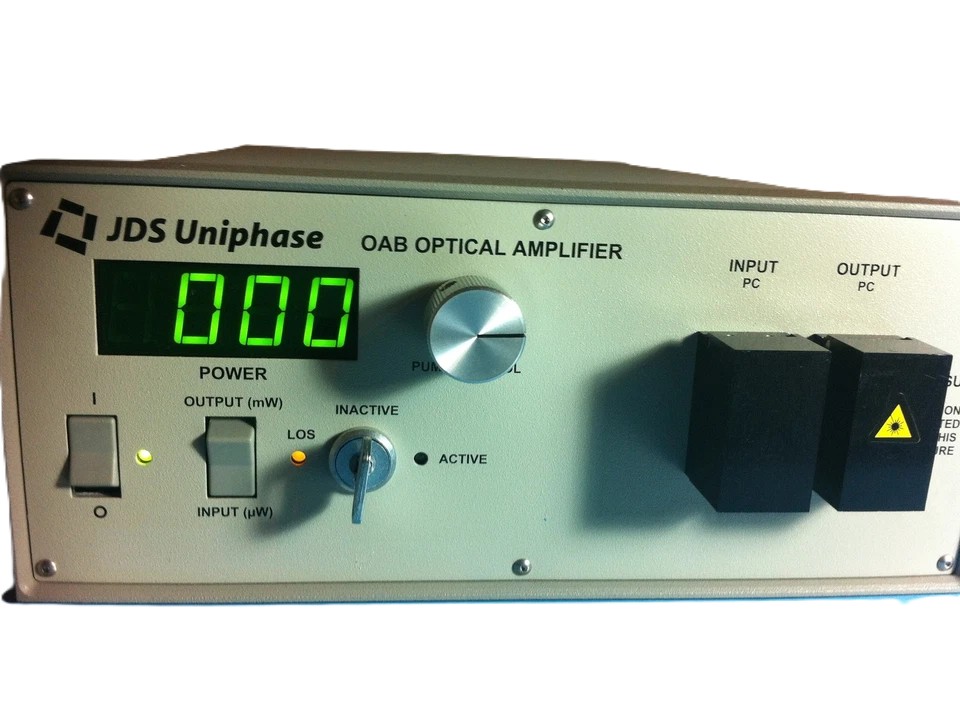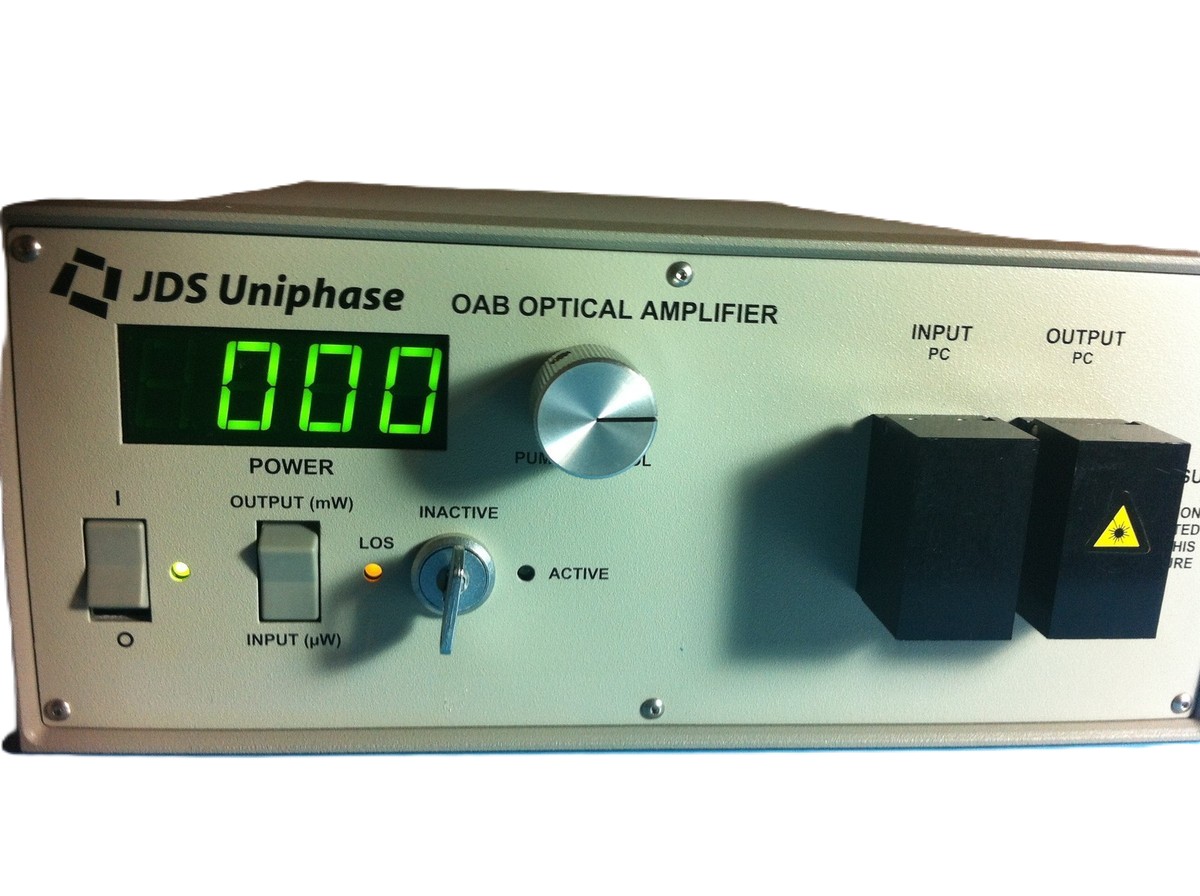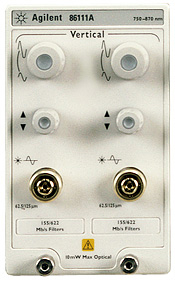
JDS Uniphase OAB 1552+20FP Erbium-Doped Fiber Amplifier
The JDS Uniphase OAB 1552+20FP is an Erbium-Doped Fiber Amplifier (EDFA) designed to boost optical signal power in fiber optic communication systems. It operates in the 1550 nm wavelength range and provides a gain of 20dB. This EDFA is suitable for long-haul transmission, metro networks, and other applications where signal amplification is needed to overcome fiber loss.
- Model
- JDS Uniphase OAB 1552+20FP
- Calibration
- Available on request
- Price · starting from
- $2,730
- Status
- In stock
- RFQ ref
- OAB 1552+20FP
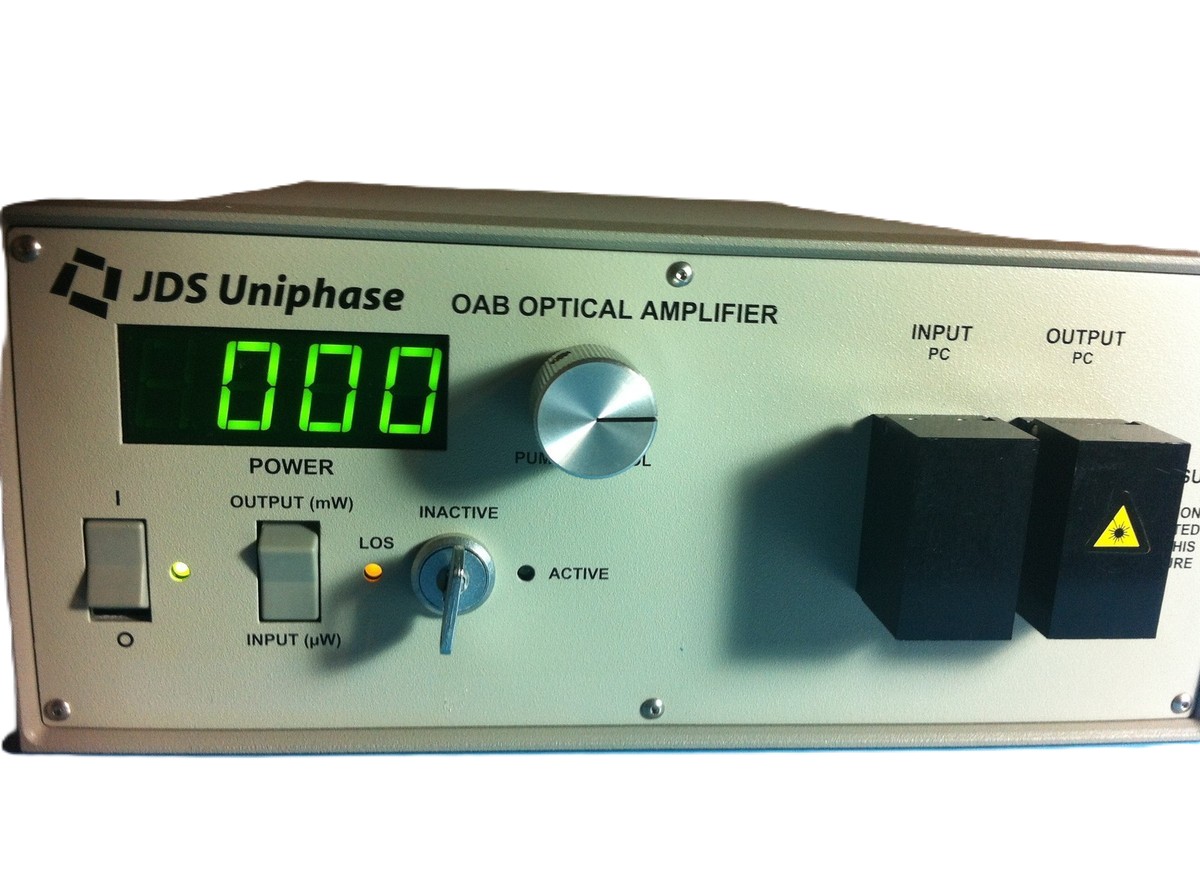
This unit
The JDS Uniphase OAB 1552+20FP is a C-band Erbium-Doped Fiber Amplifier (EDFA) booster designed for optical signal amplification across 1528–1563 nm. It delivers 20 dBm minimum saturated output power with 37 dB small signal gain and 5 dB maximum noise figure, making it suitable for long-haul and metro network applications. The amplifier uses a 980 nm pump laser and operates from a single-channel input.
Technical Specifications
- Amplifier Type: Booster
- Operating Wavelength Range: 1528–1563 nm
- Small Signal Gain: 37 dB
- Saturated Output Power (minimum): 20 dBm
- Noise Figure (maximum): 5 dB
- Pump Laser Wavelength: 980 nm
- Power Supply: 100–240 V AC, 50–60 Hz
- Dimensions: 21.2 × 8.9 × 35.5 cm
- Weight: Approximately 4 kg
Key Features
- Single-channel input signal configuration
- Gain flattening option available (selected part numbers)
- Compact benchtop form factor with optional rack-mount kit
- RS-232 remote control interface
- LAN interface (IEEE 802.3 10Base-T) for network management
- LCD front panel display showing input/output power and operational parameters
- FDA 21 CFR 1040.10 Class IIIb laser compliance; CE, UL3101-1, and CAN/CSA-C22.2 No. 1010.1 certified
Typical Applications
- Long-haul and metro transmission signal boosting
- Pre-amplifier and inline amplifier emulation
- SONET/SDH system deployment
- Manufacturing test environments and component validation
- Research and development fiber optic systems
Compatibility & Integration The OAB 1552+20FP operates as a single-channel amplifier. Other models in the OAB series support multichannel DWDM applications.
Specifications
| Parameter | Value |
|---|---|
| Power Range (dBm) | '+20 dBm (saturated output, minimum) | Voltage / Current Range: 100–240 V AC, 50–60 Hz | Wavelength Range: 1528–1563 nm |
JDS Uniphase OAB 1552+20FP — Repair & Calibration Service
Aumictech offers NIST-traceable calibration and repair for the JDS Uniphase OAB 1552+20FP. Calibration covers gain at rated input power across the specified wavelength range, noise figure at rated gain setting, output power accuracy, gain flatness across the C-band or specified wavelength range, and polarization-dependent gain (PDG) where applicable. All calibrations ship with a NIST-traceable certificate. Turnaround is typically 1–3 business days after receipt.
Common JDS Uniphase OAB 1552+20FP faults: pump laser diode degradation (gain drop, reduced output power), TEC failure causing thermal drift, optical isolator degradation, power supply failure. The most common failure on any EDFA is pump laser diode degradation. Secondary faults include TEC failure causing thermal runaway, optical isolator degradation, and power supply failure.
JDS Uniphase OAB 1552+20FP price
This JDS Uniphase OAB 1552+20FP is listed at $2,730. Calibration is available separately from $450. Contact us for volume pricing or if you need multiple units.
JDS Uniphase OAB 1552+20FP calibration cost
NIST-traceable calibration for the JDS Uniphase OAB 1552+20FP is $450 (standard — pass/fail certificate and calibration sticker) or $650 (full measured data at every test point, reference standards documented, traceability chain included). Calibration for this instrument covers gain at rated input power across the specified wavelength range, noise figure at rated gain setting, output power accuracy, gain flatness across the C-band or specified wavelength range, and polarization-dependent gain (PDG) where applicable. Turnaround is 1 to 3 business days after receipt. See full calibration details →