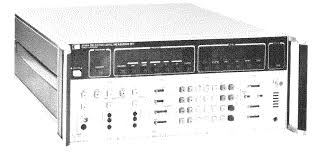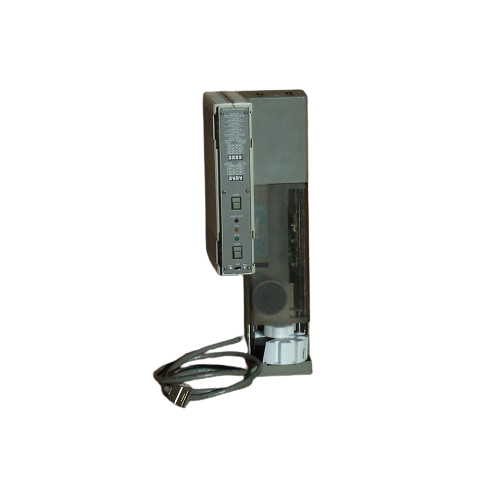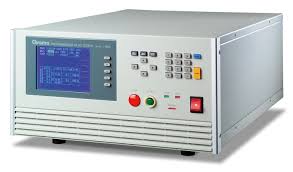
Stanford Research RGA200
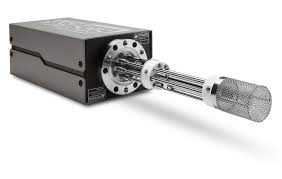
The Stanford Research Systems RGA200 is a residual gas analyzer (RGA) used for identifying and quantifying the gases present in a vacuum system. It features a mass range of 1 to 200 amu, a Faraday cup detector, and a user-friendly interface. Ideal for leak detection, vacuum system monitoring, and gas analysis applications.
- Model
- Stanford Research Systems RGA200
- Calibration
- Available on request
- Price · starting from
- $750
- Status
- In stock
- RFQ ref
- RGA200
This unit
The Stanford Research Systems RGA200 is a residual gas analyzer for vacuum system diagnostics, measuring partial pressures across a 1–200 amu mass range. The instrument combines a quadrupole probe, electronics control unit (ECU), and Windows-based software for real-time gas composition analysis and system monitoring.
Technical Specifications
Mass Range & Resolution- 1 to 200 amu
- Better than 1 amu resolution at 10% peak height; adjustable to constant peak width across the mass range Dynamic Range & Detection
A single scan covers 6 orders of magnitude with a temperature-compensated logarithmic electrometer detecting ion currents from 10⁻⁷ to 10⁻¹⁵ amps at better than 2% precision. Detection limits depend on detector choice:
- Faraday Cup: 5 × 10⁻¹¹ Torr
- Electron Multiplier: 5 × 10⁻¹⁴ Torr
(Measured at 28 amu, 1 amu peak width, 10% height, 70 eV electron energy, 12 eV ion energy, 1 mA emission current) Sensitivity
- Faraday Cup: 2 × 10⁻⁴ A/Torr
- Electron Multiplier: <200 A/Torr
User-adjustable throughout the high voltage range. Operating Conditions
- Pressure: 10⁻⁹ Torr maximum; specifications support operation to 10⁻¹⁴ Torr
- Temperature: 70 °C maximum
Key Features Ion Source & Filament Open cylindrical-symmetry ion source uses electron impact ionization with a dual thoriated-iridium (ThO₂/Ir) filament for extended service life. Built-in electron impact desorption enables ion source degassing to minimize background noise. Firmware-driven protection detects overpressure (675 Hz) and automatically shuts off the filament. Detector Options Standard Faraday cup detector measures partial pressures from 10⁻⁵ to 5 × 10⁻¹¹ Torr. Optional continuous dynode electron multiplier (CDEM) extends sensitivity to 5 × 10⁻¹⁴ Torr with faster scan rates and improved stability; user-replaceable.
Compatibility & Integration The probe mounts on a standard 2.75" Conflat flange and requires 2.5" clearance in the vacuum chamber. Rugged stainless steel construction with self-aligning components reduces outgassing. The ECU (9.1" × 4.1" × 3.1", 6 lbs) separates from the probe for independent high-temperature bake-outs. Field-replaceable filament cartridge and detector modules simplify maintenance.
Specifications
| Parameter | Value |
|---|---|
| Voltage / Current Range | 24 VDC at 2.5 A |
Stanford Research Systems RGA200 — Repair & Calibration Service
Aumictech offers NIST-traceable calibration and repair for the Stanford Research Systems RGA200. Calibration covers calibration scope varies by instrument type: vacuum gauges are verified at multiple pressure points against NIST-traceable pressure standards; spectrophotometers at wavelength accuracy and photometric accuracy points; strain gauge indicators at bridge excitation accuracy and full-scale output accuracy; pH meters against certified buffer solutions at pH 4, 7, and 10.. All calibrations ship with a NIST-traceable certificate. Turnaround is typically 1–3 business days after receipt.
Common Stanford Research Systems RGA200 faults: vacuum gauge filament failure (ionization gauges), spectrophotometer D2 lamp end-of-life, wavelength motor failure, strain indicator front-panel binding post corrosion, pH electrode conditioning failure. Most specialty laboratory instruments fail at their electromechanical interfaces first — vacuum gauge connectors and filament assemblies, spectrophotometer lamp housings and motor drives, strain indicator binding post corrosion. Component-level repair is standard; manufacturer support for legacy instruments is often limited, making third-party bench repair the practical path.
Stanford Research Systems RGA200 price
This Stanford Research Systems RGA200 is listed at $750. Calibration is available separately from $450. Contact us for volume pricing or if you need multiple units.
Stanford Research Systems RGA200 calibration cost
NIST-traceable calibration for the Stanford Research Systems RGA200 is $450 (standard — pass/fail certificate and calibration sticker) or $650 (full measured data at every test point, reference standards documented, traceability chain included). Calibration for this instrument covers calibration scope varies by instrument type: vacuum gauges are verified at multiple pressure points against NIST-traceable pressure standards; spectrophotometers at wavelength accuracy and photometric accuracy points; strain gauge indicators at bridge excitation accuracy and full-scale output accuracy; pH meters against certified buffer solutions at pH 4, 7, and 10.. Turnaround is 1 to 3 business days after receipt. See full calibration details →