Stanford Research RGA100
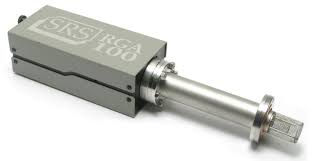
The Stanford Research Systems RGA100 is a residual gas analyzer (RGA) designed for vacuum system monitoring and analysis. It provides real-time data on the composition of gases present in a vacuum chamber, helping identify leaks, contaminants, and process-related gases. Ideal for research and industrial applications.
- Model
- Stanford Research Systems RGA100
- Calibration
- Available on request
- Price · starting from
- $750
- Status
- In stock
- RFQ ref
- RGA100
This unit
The Stanford Research Systems RGA100 is a residual gas analyzer for real-time vacuum chamber composition monitoring and analysis. It identifies leaks, contaminants, and process-related gases across a 1–100 amu mass range with sub-amu resolution and detection limits as low as 5 × 10⁻¹⁴ Torr (with electron multiplier). The instrument captures six orders of magnitude dynamic range in a single scan, enabling simultaneous measurement of trace and bulk gas species.
A temperature-compensated logarithmic electrometer detects ion currents from 10⁻¹⁵ to 10⁻⁷ amps with better than 2% precision. The dual thoriated-iridium filament is user-replaceable and includes firmware-driven overpressure protection. Faraday cup and optional electron multiplier detectors accommodate both standard and ultrahigh-sensitivity applications.
RS-232 and optional Ethernet interfaces support integration into automated vacuum control systems.
Technical Specifications
- Mass range: 1–100 amu
- Resolution: Better than 1 amu; better than 0.5 amu at 10% peak height (AVS std. 2.3); adjustable constant peak width across mass range
- Detection limit (Faraday cup): 5 × 10⁻¹¹ Torr
- Detection limit (electron multiplier, optional): 5 × 10⁻¹⁴ Torr
- Dynamic range: Six orders of magnitude per scan; ion current detection from 10⁻¹⁵ to 10⁻⁷ amps at better than 2% precision
- Sensitivity (Faraday cup): 2 × 10⁻⁴ A/Torr (N₂ at 28 amu, 70 eV electron energy, 12 eV ion energy, 1 mA emission current)
- Sensitivity (electron multiplier): <200 A/Torr (user adjustable)
- Ionizer: Open ion source with cylindrical symmetry; electron impact ionization; built-in degassing via electron impact desorption
- Power supply: External +24 VDC at 2.5 A via DB9 connector; optional AC module (110/120/220/240 VAC)
- Probe flange: Standard 2.75" ConFlat (CF)
- Probe length: 8.75" from flange face; requires 2.5" internal clearance
- Minimum tube ID: 1.375"
- ECU dimensions: 3.1" × 4.1" × 9.1" (separable for high-temperature bakeout)
- Weight: 6 lbs
Key Features
- Dual thoriated-iridium filament with field-replaceable design
- Firmware-driven filament protection with overpressure shutdown
- Stainless steel probe with self-aligning components for rapid reassembly
- Optional electron multiplier for trace-level analysis
- Logarithmic electrometer for single-scan dynamic range capture
Interfaces & Integration
- Standard RS-232 with high-level command set for program integration
- Optional Ethernet connectivity
- Detachable electronics control unit for independent vacuum system operation
Specifications
| Parameter | Value |
|---|---|
| Voltage / Current Range | 1 mA electron emission current, 12 eV ion energy, 70 eV electron energy |
Stanford Research Systems RGA100 — Repair & Calibration Service
Aumictech offers NIST-traceable calibration and repair for the Stanford Research Systems RGA100. Calibration covers calibration scope varies by instrument type: vacuum gauges are verified at multiple pressure points against NIST-traceable pressure standards; spectrophotometers at wavelength accuracy and photometric accuracy points; strain gauge indicators at bridge excitation accuracy and full-scale output accuracy; pH meters against certified buffer solutions at pH 4, 7, and 10.. All calibrations ship with a NIST-traceable certificate. Turnaround is typically 1–3 business days after receipt.
Common Stanford Research Systems RGA100 faults: vacuum gauge filament failure (ionization gauges), spectrophotometer D2 lamp end-of-life, wavelength motor failure, strain indicator front-panel binding post corrosion, pH electrode conditioning failure. Most specialty laboratory instruments fail at their electromechanical interfaces first — vacuum gauge connectors and filament assemblies, spectrophotometer lamp housings and motor drives, strain indicator binding post corrosion. Component-level repair is standard; manufacturer support for legacy instruments is often limited, making third-party bench repair the practical path.
Stanford Research Systems RGA100 price
This Stanford Research Systems RGA100 is listed at $750. Calibration is available separately from $450. Contact us for volume pricing or if you need multiple units.
Stanford Research Systems RGA100 calibration cost
NIST-traceable calibration for the Stanford Research Systems RGA100 is $450 (standard — pass/fail certificate and calibration sticker) or $650 (full measured data at every test point, reference standards documented, traceability chain included). Calibration for this instrument covers calibration scope varies by instrument type: vacuum gauges are verified at multiple pressure points against NIST-traceable pressure standards; spectrophotometers at wavelength accuracy and photometric accuracy points; strain gauge indicators at bridge excitation accuracy and full-scale output accuracy; pH meters against certified buffer solutions at pH 4, 7, and 10.. Turnaround is 1 to 3 business days after receipt. See full calibration details →